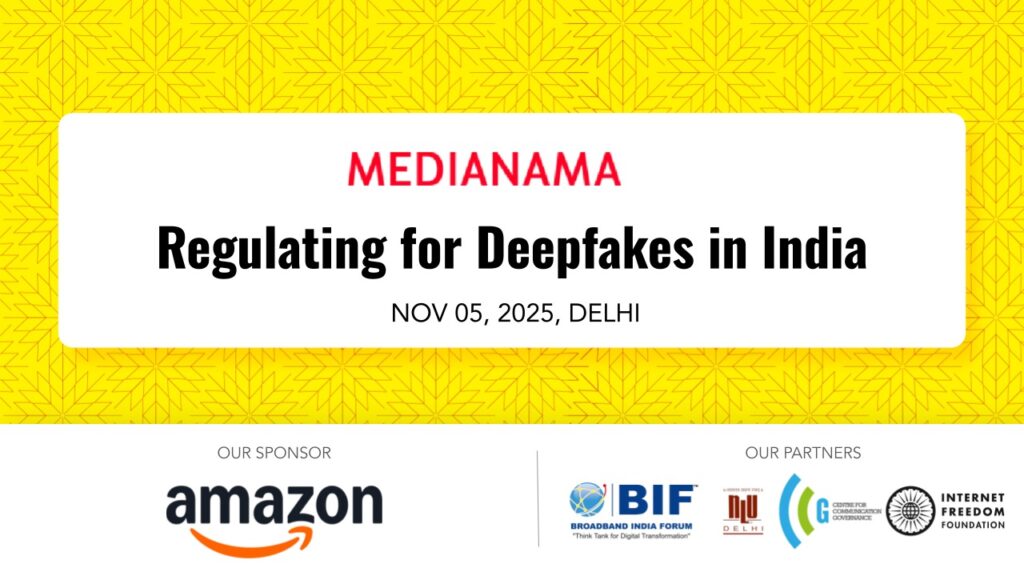

On November 5, 2025, in Delhi, industry experts and policymakers convened at the MediaNama-organised panel discussion “Regulating for Deepfakes in India” to examine the evolving terrain of AI-generated media and proposed regulation in India.
At the heart of the discussion lies a draft amendment to the Information Technology (Intermediary Guidelines and Digital Media Ethics Code) Rules, 2021, released by the Ministry of Electronics and Information Technology (MeitY). The amendment proposes a regulatory framework for synthetically generated content that mandates creators, platforms, and AI-tool vendors to embed visible or audible labels, watermarks, and invariant metadata in any AI-produced media, while expanding due diligence obligations for intermediaries.
As the amendment is currently open to consultation and feedback, it becomes important to ask: is mandatory labelling the most effective way to counter the risks posed by deepfakes, or should emphasis shift toward detecting manipulated content through AI-powered forensics?
Labelling Content And Freedom Of Speech
A participant at the discussion highlighted how the draft amendment on deepfakes intersects with the constitutional right to freedom of speech and expression under Article 19(1)(a) and its limitations under Article 19(2).
Furthermore, they explained that while the government can impose “reasonable restrictions” on free speech, such restrictions must have “a basis or a justification which stands up”. The participant noted that the current justification, preventing misinformation and protecting reputations, appears “self-evident” but questioned whether this extends beyond what the Constitution permits.
They argued that damage to reputations is not the same as defamation, pointing out a broader trend where the Union government attempts to expand the scope of Article 19(2). Recalling past cases, the participant referred to Shreya Singhal (2015), where the Supreme Court had firmly held that the government must “be within 19(2)”, despite its request for more flexibility to regulate online speech.
Yet, they noted, the government has continued to make similar arguments—in the Kaushal Kishore and Kunal Kamra case — only to be struck down again. However, they cautioned that a recent Karnataka High Court ruling in XCOP v. Union of India has weakened that standard. “The fundamental issue”, the participant concluded, “is that we do not know why this regulation is being made.”
However, another participant argued that simply labelling synthetic media does not constitute a violation of freedom of speech. “Merely labelling content does not necessarily mean controlling speech. The idea of labelling is to give the user or whoever’s viewing that piece of content more context or more information to make a decision. What happens after a label, typically on platforms, is that platform enforcement kicks in,” they point out.
Source link
Disclaimer
We strive to uphold the highest ethical standards in all of our reporting and coverage. We blogs.grocliq.com want to be transparent with our readers about any potential conflicts of interest that may arise in our work. It’s possible that some of the investors we feature may have connections to other businesses, including competitors or companies we write about. However, we want to assure our readers that this will not have any impact on the integrity or impartiality of our reporting. We are committed to delivering accurate, unbiased news and information to our audience, and we will continue to uphold our ethics and principles in all of our work. Thank you for your trust and support.
Website Upgradation is going on for any glitch kindly connect at [email protected]