
MediaNama’s Take:
Karnataka’s proposed Misinformation Bill, with its promise to “name and shame” individuals accused of spreading “falsehoods”, raises significant free speech-related questions, especially that of press freedom, as the previous leaked draft recommends a state-appointed fake news regulatory authority to oversee the enforcement of the bill.
Moreover, a more concerning aspect is the practicality of tracing the “originator” of fake information, especially in the era of end-to-end encryption (E2EE), where much of the misinformation spreads through platforms such as WhatsApp, which told the Delhi High Court last year that it would stop offering its services in India if the government compelled it to break E2EE.
And even if the Karnataka government manages to trace the originator of a particular “fake information”, the question of who faces the liability still remains unsolved: who should face responsibility, the creator, the first person to circulate and amplify the false information, the user whose post went viral, those who shared it, or the person who altered it with “malicious intent”? Moreover, what mechanism would the agencies or the government follow to prove malicious intent?
And if the government wants to regulate online free speech in an ecosystem driven by algorithms, bots, and political party IT cells operating both officially and unofficially, it may face a significant challenge in distinguishing between malicious intent and genuine misunderstanding or misquoting without intent to harm.
As such, false accusations and flaggings could lead to serious violations of fundamental rights if the government fails to follow constitutional due diligence.
What’s the News?
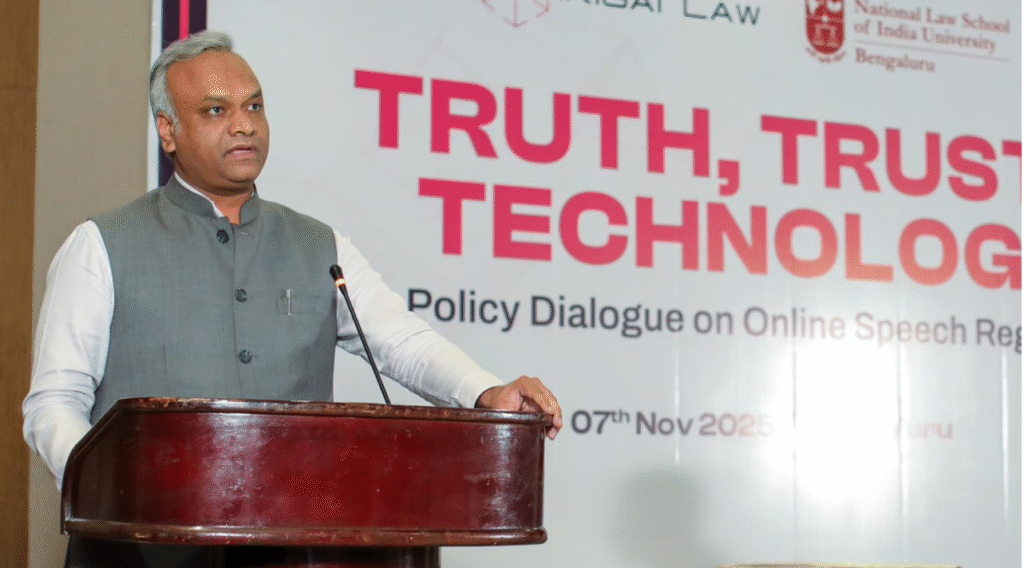
Karnataka’s Minister of Electronics, Information Technology & Biotechnology, Priyank Kharge said that the new draft of the state’s Misinformation Bill plans to “name and shame” individuals who deliberately spread false information online.
“We want to name and shame people who deliberately mislead the public,” Kharge said during the keynote address at the“Truth, Trust and Technology” public policy discussion hosted by the National Law School of India University (NLSIU), and Ikigai Law in Bengaluru, on Friday, 7 November 2025.
He also revealed that the bill is expected to be introduced in Karnataka’s next winter session, which is scheduled for December, with input from legal experts and the Home Department.
“Our intent is not to target those who question or criticise the government but to ensure that truth travels faster than lies and that trust triumphs over fear,” Kharge said.
What Is The Misinformation Bill, And Why Are We Talking About It Now?
The discussion around Karnataka’s Misinformation Bill began after a draft copy of the bill leaked online. According to a Newslaundry report, the draft copied portions from a private bill introduced in the Indian Parliament in…
Source link
Disclaimer
We strive to uphold the highest ethical standards in all of our reporting and coverage. We blogs.grocliq.com want to be transparent with our readers about any potential conflicts of interest that may arise in our work. It’s possible that some of the investors we feature may have connections to other businesses, including competitors or companies we write about. However, we want to assure our readers that this will not have any impact on the integrity or impartiality of our reporting. We are committed to delivering accurate, unbiased news and information to our audience, and we will continue to uphold our ethics and principles in all of our work. Thank you for your trust and support.
Website Upgradation is going on for any glitch kindly connect at [email protected]