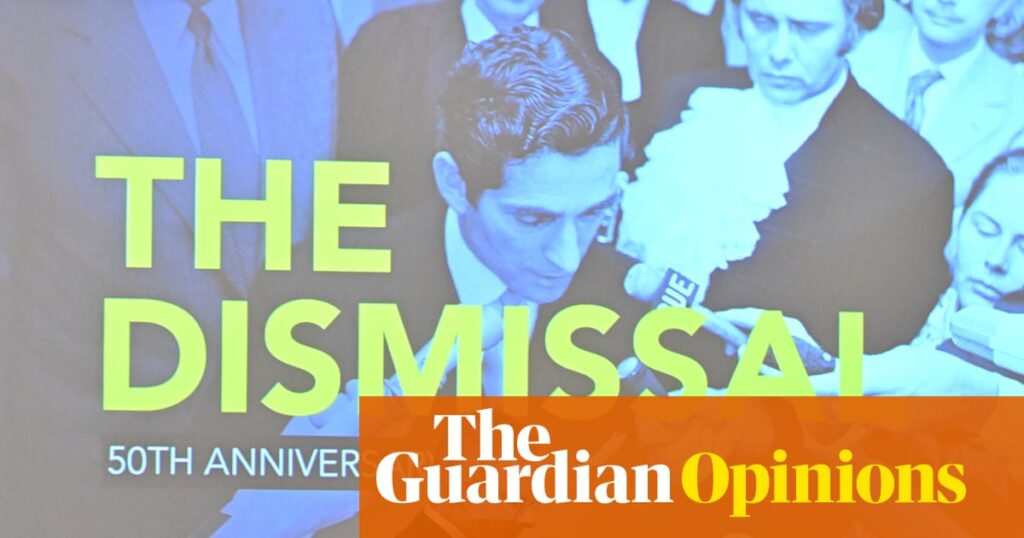

I’m too young to have been an eyewitness to the dismissal, but the memory of Dad coming home from Trades Hall pissed off and two parts shot and telling nine-year-old me to watch the telly because “this is important” was my introduction to politics.
In the lead-up to Tuesday’s 50th anniversary of our bloodless coup, I’ve been immersing myself in footage from that day, reflecting on what the great man would have made of the current government that carries his flame.
Whitlam’s removal after less than three years in office by the crown (amid suspicion of deeper US involvement which persists to this day) has shaped Labor in two contradictory ways: the resilience of his ambition and the danger inherent in pursuing such grandeur.
It would be unfair to say the Hawke-Keating government that followed eight years later lacked vision; their economic reforms were bold albeit aligned to the dominant force of neoliberal globalisation, tempered by a self-moderation born of the perceived overreach of the Whitlam project.
After the Rudd-Gillard-Rudd governments imploded with Whitmanesque drama, it’s tempting to see the Albanese government as an inheritor of the Hawke-Keating mantle. Indeed, this year’s election cast Labor as the party of stability in a time of global chaos.
But there are also echoes of Whitlam that reverberate deep in this government’s DNA, anchored by a prime minister who served his apprenticeship to Tom Uren, another larger-than-life figure who survived the Thai-Burma railway to become a key minister under Gough.
The Medicare card that was Albo’s constant companion through the election campaign has a living through-line to Whitlam, who created the universal health system that is so central to our national identity and the envy of much of the world.
The majority women in the Albanese government may stand in stark contrast to paucity of women in Whitlam’s (there wasn’t a single elected woman until 1974), but his recognition via equal pay and no-fault divorce, modelled through his partnership with the formidable Margaret, are the genesis of that cultural shift.
I’ve been thinking about Whitlam as I observe the current government’s struggle to navigate what could be the most consequential technological challenge since the 1970s: the rapid diffusion of artificial intelligence.
The latest Guardian Essential Report reinforces that this change is happening fast, with particularly younger Australians integrating AI into their work, their broader lives and even their relationships.
How this technology may (or may not) be regulated is currently an open question, with industry and tech boosters pushing for a hands-off approach, while unions, advocates and the broader public seek a more rules-based framework.
Given his career predated the Commodore 64, I’m not expecting Gough to give much guidance when it comes to the actual design of AI policy, but I do think the broader approach to such a big challenge could be informed by some…
Source link
Disclaimer
We strive to uphold the highest ethical standards in all of our reporting and coverage. We blogs.grocliq.com want to be transparent with our readers about any potential conflicts of interest that may arise in our work. It’s possible that some of the investors we feature may have connections to other businesses, including competitors or companies we write about. However, we want to assure our readers that this will not have any impact on the integrity or impartiality of our reporting. We are committed to delivering accurate, unbiased news and information to our audience, and we will continue to uphold our ethics and principles in all of our work. Thank you for your trust and support.
Website Upgradation is going on for any glitch kindly connect at [email protected]