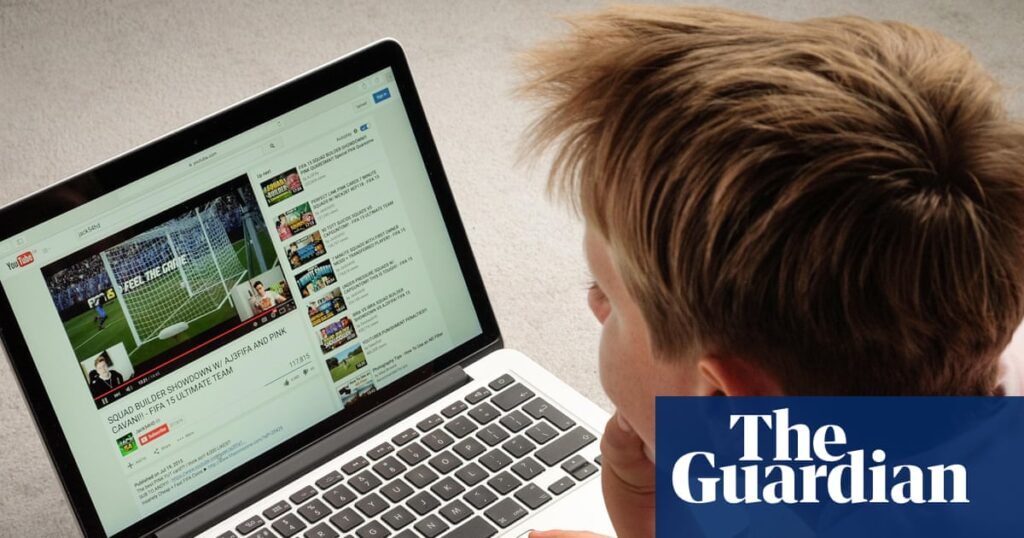

Lots of children’s programming made for YouTube is “not entertainment, it’s sedation”, the UK children’s laureate has warned.
Frank Cottrell-Boyce said that “frictionless” programming in which children are “bombarded with information” such as CoCoMelon, a YouTube Kids channel with 180 million subscribers, fails to offer the “stimulation and nourishment” that previous generations enjoyed.
Speaking to MPs in the opening evidence session of the culture, media and sport committee’s inquiry into children’s TV and video content, Cottrell-Boyce said research showed that for young children, “repetition is good because you’re building familiarity, and slowness is good because you’re making life navigable”.
“I feel very privileged to have grown up in an era when lots of children’s television had those qualities,” he said.
The fragmented media landscape means that children today miss out on the sense of “national unity and national identity” that comes with watching the same shows. “Shared culture is disappearing and what’s left is an individual anxiety factory. I’ve been visiting schools for 20 years and I’ve seen anxiety levels rocket,” he said.
Cottrell-Boyce feared that platforms such as YouTube gave “the illusion of choice, but because it’s algorithmically driven, you default to more and more of the same”, while AI was “ossifying what we’ve already done”.
He added: “You can’t take that much out and put nothing in and expect the thing you’re feeding off to survive.”
Greg Childs OBE, director of the Children’s Media Foundation and a veteran BBC children’s producer, agreed that the children’s TV industry was “broken” and that UK production companies were “going to the wall”.
Noting that 62% of viewing by under-16s was on YouTube and only 22% on broadcast TV, he said the former had “captured the eyeballs, imaginations and interest of a nation – but they haven’t replaced the system that existed before which is a curated system of content”.
“Children’s wellbeing is damaged or not fostered by the algorithmic recommendation systems, they’re falling down rabbit holes of all sorts of content,” he said.
He said YouTube did not provide any upfront investment to fund new shows, and that the “creator economy” does not exist for children’s TV due to its advertising rules.
As a result, people who make kids content receive 80 to 90% less in revenue than other creators, despite the Children’s Media Foundation estimating that YouTube made £700m from children’s advertising in one year, he said.
YouTube needed a “form of regulation and ratings system” and the government should force the platform to act in the public interest if it does not do so voluntarily, he said. “The algorithm is capable of change … We would like Google and YouTube to become part of society rather than apart from society,” he added.
Childs urged the government to commit funding…
Source link
Disclaimer
We strive to uphold the highest ethical standards in all of our reporting and coverage. We blogs.grocliq.com want to be transparent with our readers about any potential conflicts of interest that may arise in our work. It’s possible that some of the investors we feature may have connections to other businesses, including competitors or companies we write about. However, we want to assure our readers that this will not have any impact on the integrity or impartiality of our reporting. We are committed to delivering accurate, unbiased news and information to our audience, and we will continue to uphold our ethics and principles in all of our work. Thank you for your trust and support.
Website Upgradation is going on for any glitch kindly connect at [email protected]