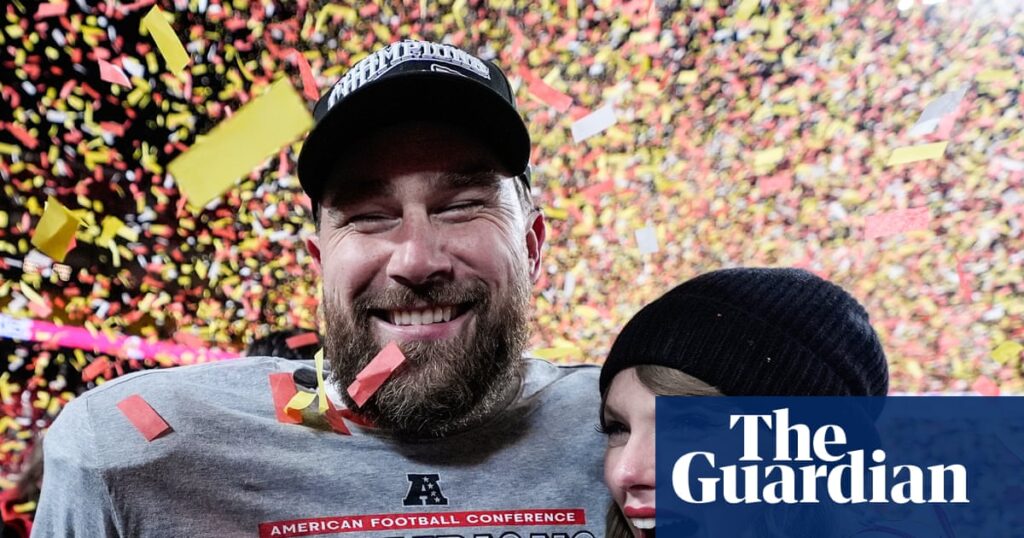

If you’re wondering why Taylor Swift didn’t respond to your social media post offering congratulations on her engagement, then Cambridge Dictionary has a word for you: parasocial.
Defined as “involving or relating to a connection that someone feels between themselves and a famous person they do not know”, parasocial has been chosen by the dictionary as its word of the year, as people turn to chatbots, influencers and celebrities to feel connection in their online lives.
The term first emerged in 1956 when University of Chicago sociologists observed TV viewers engaging in “para-social” relationships with onscreen personalities, mirroring their bonds with family and friends – except this was a one-way attachment.
Opportunities for asymmetrical relationships have mushroomed in the internet era, with social media and now artificial intelligence taking a niche academic term into the mainstream.
“Parasocial captures the 2025 zeitgeist,” said Colin McIntosh, a Cambridge Dictionary editor. “Millions of people are engaged in parasocial relationships; many more are simply intrigued by their rise. The data reflects that, with the Cambridge Dictionary website seeing spikes in lookups for ‘parasocial’.”
The dictionary cited Swift’s engagement to NFL star Travis Kelce and Lily Allen’s confessional breakup album West End Girl as parasocial moments of the year, with AI chatbots also getting a mention as they become confidants, friends or romantic partners.
Simone Schnall, professor of experimental social psychology at the University of Cambridge, said parasocial relationships have “redefined fandom, celebrity and, with AI, how ordinary people interact online”.
Schnall said people have turned to influencers as trust in mainstream and traditional media breaks down, which can lead to “unhealthy and intense relationships” with social media stars. Meanwhile, parasocial ties with celebrities like Swift can lead to obsessive interpretations of lyrics and heated online discussions.
after newsletter promotion
Young people are particularly susceptible to chatbots offering the illusion of a relationship.
“Parasocial trends take on a new dimension as many people treat AI tools like ChatGPT as ‘friends’, offering positive affirmations, or as a proxy for therapy,” she said.
The dictionary added or updated…
Source link
Disclaimer
We strive to uphold the highest ethical standards in all of our reporting and coverage. We blogs.grocliq.com want to be transparent with our readers about any potential conflicts of interest that may arise in our work. It’s possible that some of the investors we feature may have connections to other businesses, including competitors or companies we write about. However, we want to assure our readers that this will not have any impact on the integrity or impartiality of our reporting. We are committed to delivering accurate, unbiased news and information to our audience, and we will continue to uphold our ethics and principles in all of our work. Thank you for your trust and support.
Website Upgradation is going on for any glitch kindly connect at [email protected]