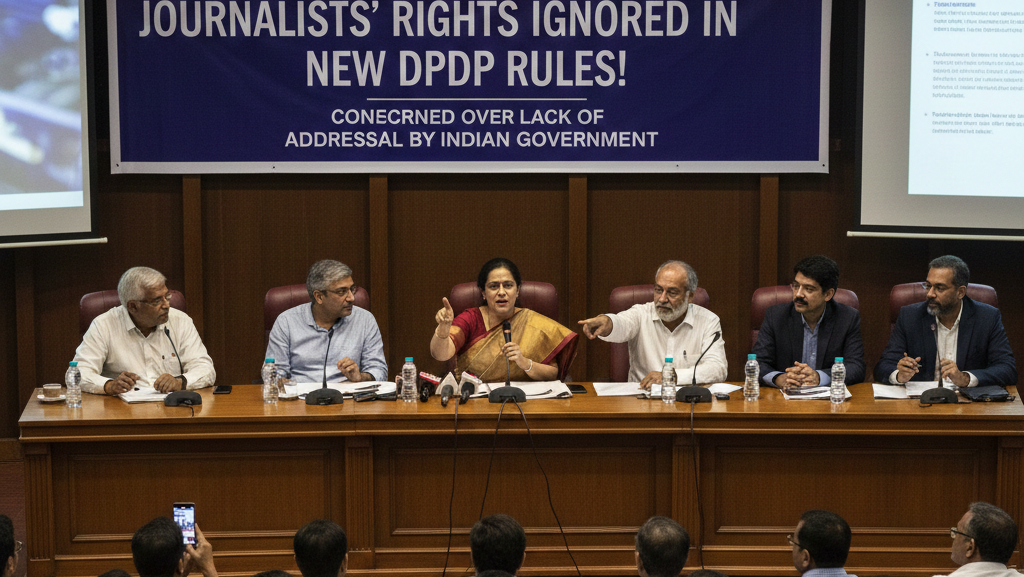

The Press Club of India (PCI) has criticised the Ministry of Electronics and Information Technology (MeitY) for notifying the Digital Personal Data Protection (DPDP) Rules, 2023, without addressing concerns raised by journalists about the impact of the law on press freedom.
PCI said the Ministry’s manner of notifying the Digital Personal Data Protection Rules has deeply anguished it and argued that the law, in its current form, includes several ambiguous provisions that authorities could misuse against journalists.
Journalists Warn of Threat to Article 19(1)
In June 2025, the PCI and 22 other press organisations submitted a joint memorandum to MeitY. They warned that the DPDP Act’s broad definitions and wide scope could interfere with newsgathering, reporting, and the constitutional right to freedom of expression under Article 19(1).
The memorandum also highlighted that journalists were not seeking to repeal the law but wanted safeguards so that authorities could not “weaponise” the Act against the media.
Meeting With MeitY and Follow-up Queries
Following the memorandum, MeitY Secretary S. Krishnan met representatives of the press bodies on July 28, 2025. On his request, journalists submitted a detailed set of 35 Frequently Asked Questions (FAQs) on August 22, 2025. These questions listed real journalistic scenarios and sought clarity on how different sections of the Act, specifically Sections 2, 5, 6, 7, 10, 17, 28, 33, 36 and 37, would apply.
Journalists also provided a copy of Article 85 of the EU’s General Data Protection Regulation (GDPR), which explicitly grants exemptions for journalistic work. This was submitted after officials sought a reference model.
Concerns Over Ambiguity and RTI Dilution
Both the memorandum and the FAQs warned that authorities could use vague provisions in the DPDP Act to restrict reporting. Press bodies said this could hinder day-to-day journalism, including news gathering, data processing, and storing sensitive information for public-interest reporting.
They also raised concern about the amendment to Section 8(1)(j) of the Right to Information (RTI) Act through Section 44 of the DPDP Act, saying the change weakens journalists’ ability to access public records. According to the press bodies, the earlier RTI provision was a crucial tool for holding authorities accountable.
Efforts to Engage ‘Met With Obfuscation’
The PCI stated that journalists went “the extra yard” to engage constructively with the government, pointing out legal gaps and offering solutions. They said their efforts were meant…
Source link
Disclaimer
We strive to uphold the highest ethical standards in all of our reporting and coverage. We blogs.grocliq.com want to be transparent with our readers about any potential conflicts of interest that may arise in our work. It’s possible that some of the investors we feature may have connections to other businesses, including competitors or companies we write about. However, we want to assure our readers that this will not have any impact on the integrity or impartiality of our reporting. We are committed to delivering accurate, unbiased news and information to our audience, and we will continue to uphold our ethics and principles in all of our work. Thank you for your trust and support.
Website Upgradation is going on for any glitch kindly connect at [email protected]