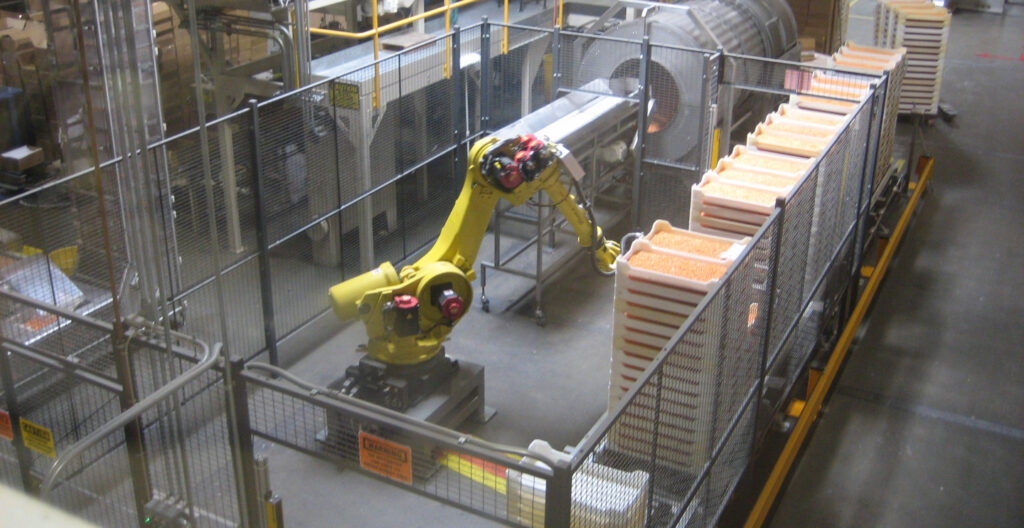

Manufacturers today are working against rising input costs, labour shortages, supply-chain fragility, and pressure to offer more customised products. AI is becoming an important part of a response to those pressures.
When enterprise strategy depends on AI
Most manufacturers seek to reduce cost while improving throughput and quality. AI supports these aims by predicting equipment failures, adjusting production schedules, and analysing supply-chain signals. A Google Cloud survey found that more than half of manufacturing executives are using AI agents in back-office areas like planning and quality. (https://cloud.google.com/transform/roi-ai-the-next-wave-of-ai-in-manufacturing)
The shift matters because the use of AI links directly to measurable business outcomes. Reduced downtime, lower scrap, better OEE (overall equipment effectiveness), and improved customer responsiveness all contribute to positive enterprise strategy and overall competitiveness in the market.
What recent industry experience reveals
-
Motherson Technology Services reported major gains – 25-30% maintenance-cost reduction, 35-45% downtime reduction, and 20-35% higher production efficiency after adopting agent-based AI, data-platform consolidation, and workforce-enablement initiatives.
-
ServiceNow has described how manufacturers unify workflows, data, and AI on common platforms. It reported that just over half of advanced manufacturers have formal data-governance programmes in support of their AI initiatives.
These instances show the direction of travel: AI is being deployed inside operations – not in pilots, but in workflows.
What cloud and IT leaders should consider
Data architecture
Manufacturing systems depend on low-latency decisions, especially for maintenance and quality. Leaders must work out how to combine edge devices (often OT systems with supporting IT infrastructure) with cloud services. Microsoft’s maturity-path guidance highlights that data silos and legacy equipment remain a barrier, so standardising how data is collected, stored, and shared is often the first step for many future-facing manufacturing and engineering businesses.
Use-case sequencing
ServiceNow advises starting small and scaling AI roll-outs gradually. Focusing on two or three high-value use-cases helps teams avoid the “pilot trap”. Predictive maintenance, energy optimisation, and quality inspection are strong starting points because benefits are relatively easy to measure.
Governance and security
Connecting operational technology equipment with IT and cloud systems increases cyber-risk, as some OT systems were not designed to be exposed to the wider internet. Leaders should define data-access rules and monitoring requirements carefully. In general, AI governance should not wait until later phases, but begin in the first pilot.
Workforce and skills
The human factor remains important. Operators’ trust AI-supported systems goes without saying and there needs to be confidence using systems underpinned by…
Source link
Disclaimer
We strive to uphold the highest ethical standards in all of our reporting and coverage. We blogs.grocliq.com want to be transparent with our readers about any potential conflicts of interest that may arise in our work. It’s possible that some of the investors we feature may have connections to other businesses, including competitors or companies we write about. However, we want to assure our readers that this will not have any impact on the integrity or impartiality of our reporting. We are committed to delivering accurate, unbiased news and information to our audience, and we will continue to uphold our ethics and principles in all of our work. Thank you for your trust and support.
Website Upgradation is going on for any glitch kindly connect at [email protected]