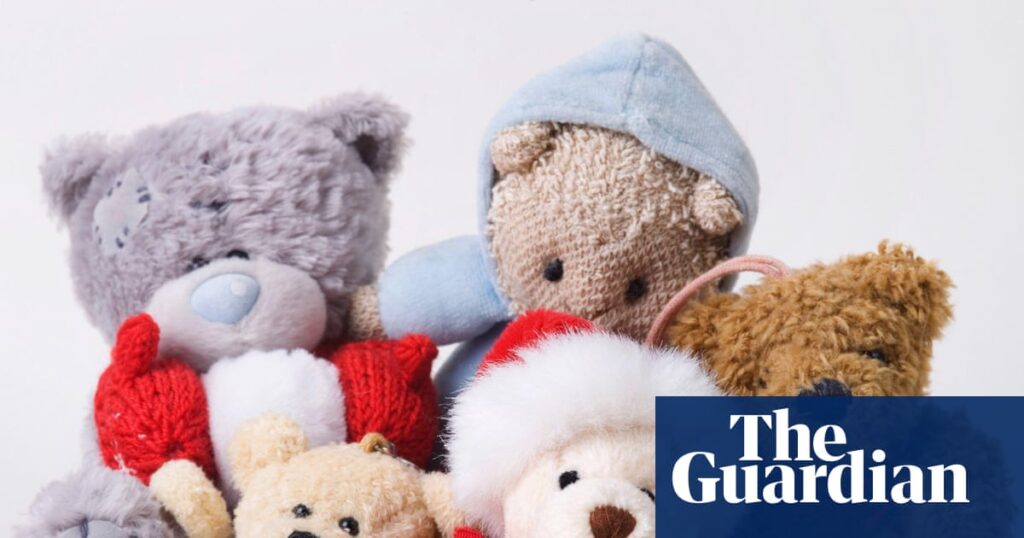

As the holiday season looms into view with Black Friday, one category on people’s gift lists is causing increasing concern: products with artificial intelligence.
The development has raised new concerns about the dangers smart toys could pose to children, as consumer advocacy groups say AI could harm kids’ safety and development. The trend has prompted calls for increased testing of such products and governmental oversight.
“If we look into how these toys are marketed and how they perform and the fact that there is little to no research that shows that they are beneficial for children – and no regulation of AI toys – it raises a really big red flag,” said Rachel Franz, director of Young Children Thrive Offline, an initiative from Fairplay, which works to protect children from big tech.
Last week, those fears were given brutal justification when an AI-equipped teddy bear started discussing sexually explicit topics.
The product, FoloToy’s Kumma, ran on an OpenAI model and responded to questions about kink. It suggested bondage and roleplay as ways to enhance a relationship, according to a report from the Public Interest Research Group (Pirg), the consumer protection organization behind the study.
“It took very little effort to get it to go into all kinds of sexually sensitive topics and probably a lot of content that parents would not want their children to be exposed to,” said Teresa Murray, Pirg consumer watchdog director.
Products like the teddy bear are part of a global smart-toy market valued at $16.7bn in 2023, according to Allied Market Research.
The industry is particularly big in China, which has more than 1,500 AI toy companies, which are working to expand abroad, MIT Technology Review reports.
In addition to the Shanghai-based startup FoloToy, Curio, a California-based company, works with OpenAI and makes a stuffed toy, Grok, as in Elon Musk’s chatbot, voiced by the musician Grimes. In June, Mattel, which owns brands like Barbie and Hot Wheels, also announced a partnership with OpenAI to “support AI-powered products and experiences”.
Before the Pirg report on the creepy teddy bear, parents, technology researchers and lawmakers had already raised concerns about the impact of bots on minors’ mental health. In October, the chatbot company Character.AI announced that it would ban users under 18 following a lawsuit alleging that its bot exacerbated a teen’s depression and caused him to kill himself.
Murray said AI toys could be particularly dangerous because whereas earlier smart toys provided children-programmed responses, a bot can “have a free-flowing conversation with a child and there are no boundaries, as we found”.
That could not only lead to sexually explicit conversations, but children could become attached to a bot rather than a person or imaginary friend, which could hurt their development, said Jacqueline Woolley, director of the Children’s Research Center at the University of Texas at Austin.
For…
Source link
Disclaimer
We strive to uphold the highest ethical standards in all of our reporting and coverage. We blogs.grocliq.com want to be transparent with our readers about any potential conflicts of interest that may arise in our work. It’s possible that some of the investors we feature may have connections to other businesses, including competitors or companies we write about. However, we want to assure our readers that this will not have any impact on the integrity or impartiality of our reporting. We are committed to delivering accurate, unbiased news and information to our audience, and we will continue to uphold our ethics and principles in all of our work. Thank you for your trust and support.
Website Upgradation is going on for any glitch kindly connect at [email protected]