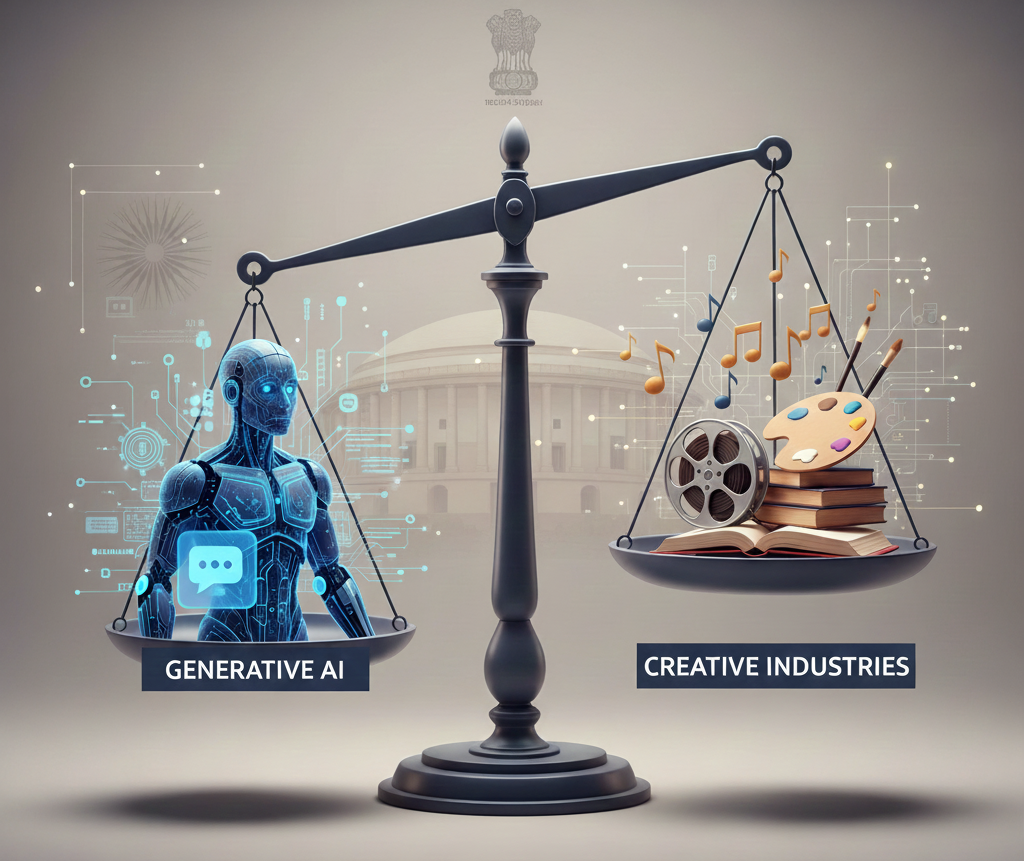

India’s new copyright working paper proposes setting up a central organisation called the Copyright Royalties Collective for AI Training (CRCAT). This body would run licensing and royalty governance for AI developers. If implemented, CRCAT becomes the single gatekeeper that enforces rates, ensures compliance, and distributes payments to creators whose work trains generative AI models.
For context, CRCAT sits at the centre of the Department for Promotion of Industry and Internal Trade (DPIIT) committee’s proposed mandatory licensing model. Developers would gain automatic rights to use any lawfully accessed copyrighted works for training, while creators receive revenue-linked royalties. Notably, rights holders cannot opt out.
The system aims to simplify licensing by preventing developers from negotiating with thousands of creators. However, the proposal concentrates operational power in a single organisation that does not yet exist and depends heavily on copyright societies and collective management organisations (CMOs) that vary widely across sectors. Additionally, the framework assumes new CMOs will emerge over time to cover categories that currently have no collective representation.
Here’s a closer look at how CRCAT is structured, who participates, and how it would work in practice.
How is CRCAT Supposed To Work?
CRCAT would function as a nonprofit designated by the central government under the Copyright Act. Only one organisation can represent each class of copyrighted works. That representative must be either a registered copyright society under Section 33 of the Copyright Act or a newly formed nonprofit collective management organisation.
Sectors without either structure would send government-nominated representatives to the CRCAT board until they form their own CMO. The governing board includes one representative from each member organisation and temporary representatives from unorganised sectors. The design aims to ensure that every creative category eventually holds a seat in royalty calculations.
CRCAT handles four core functions: collecting royalties from AI developers, distributing funds to CMOs and societies, enforcing compliance, and operating the Works Database that determines payout eligibility. The framework positions CRCAT as the administrative funnel through which all money, data, and compliance flow. Developers never pay creators directly, and creators never negotiate with developers.
How Royalties Would Be Set and Calculated?
A government-appointed Rate Setting Committee, not CRCAT, decides royalty rates. The committee includes senior officials, legal and financial experts, technical experts, one representative from CRCAT, and one from AI developers. It reviews rates every three years.
The committee rejects granular valuation methods, such as per-use accounting, because AI developers cannot trace how individual works influence outputs. Instead, it proposes a flat percentage of…
Source link
Disclaimer
We strive to uphold the highest ethical standards in all of our reporting and coverage. We blogs.grocliq.com want to be transparent with our readers about any potential conflicts of interest that may arise in our work. It’s possible that some of the investors we feature may have connections to other businesses, including competitors or companies we write about. However, we want to assure our readers that this will not have any impact on the integrity or impartiality of our reporting. We are committed to delivering accurate, unbiased news and information to our audience, and we will continue to uphold our ethics and principles in all of our work. Thank you for your trust and support.
Website Upgradation is going on for any glitch kindly connect at [email protected]