
Universal basic income (UBI) is back, like a space zombie in a sci-fi movie, resurrected from policy oblivion, hungry for policymakers’ attention: brains!
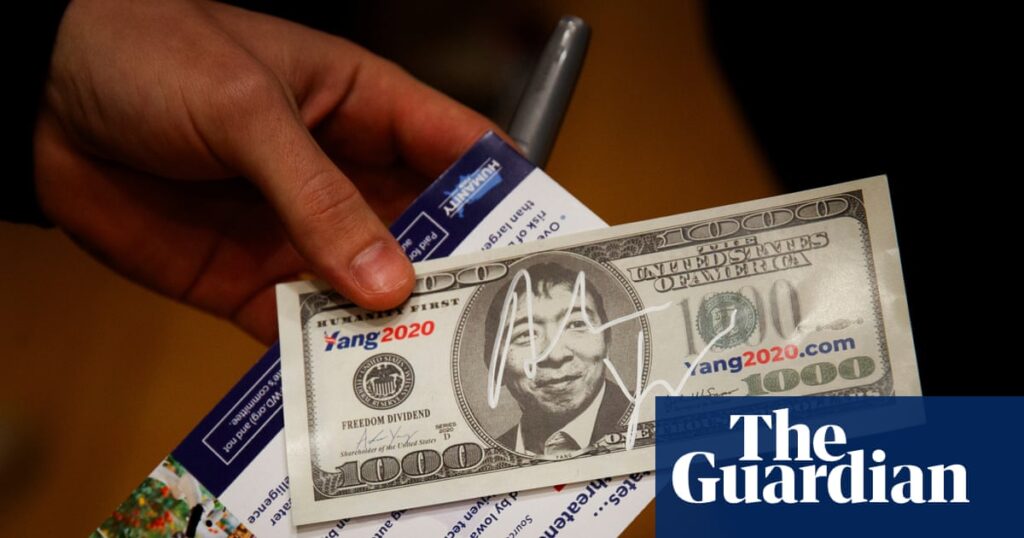
Andrew Yang, whose “Yang Gang” enthusiasm briefly shook up the Democratic presidential nomination in 2020 promoting a “Freedom Dividend” to save workers from automation – $1,000 a month for every American adult – is again the main carrier of the bug: offering UBI to save the nation when robots eat all our jobs.
This time Chat GPT, Yang hopes, will help his argument land: if artificial intelligence truly makes human labor redundant, as so many citizens of the tech bubble in Silicon Valley expect, society will need something other than employment for all of us to make ends meet.
Yet while the warning rings true, the prescription still falls flat. We will need something big and new to spread money around if some super-human intelligence comes for all the jobs. But a UBI, as contemplated by its current cheerleaders, does not start to address the real challenges of an economy that has moved past human labor.
Ask a truck driver (Yang was worried about truck drivers) to live on $1,000 a month. A two-parent, two-kid family on the “Freedom Dividend” would be pretty deep under water, living on 25% less than needed to poke through the poverty line.
The bill to provide every adult a guaranteed income worth, say, $53,000 per year, equivalent to the median earnings of American workers, would add up to over $14tn, about 45% of the United States’ gross domestic product (GDP). Good luck to the politician running on a platform to fund this brave new world.
To put it in perspective, since 1980, the first year for which the Organisation for Economic Co-operation and Development publishes that data, public social spending in the United States – covering health, pensions, disability, unemployment insurance and all that – has never hit 25% of the GDP. Indeed, since the 1960s, the aggregate tax revenue raised by all levels of government has never reached 30% of GDP.
And this doesn’t even consider how challenging redistribution will become once AI kills all labor income, which today generates most tax revenue.
Yang suggested funding his “Freedom Dividend” with a value added tax. This is a tax on consumption that the US does not use but funds a big chunk of Europe’s welfare states. It has merits: It can raise a lot of money, because it is easy to collect at the store checkout, and it does not sap incentives to work and invest, as income taxes do. But it seems a bit ridiculous to propose a world without work in which the livelihoods of most people are funded with a tax on what they buy.
If it meets its investors’ lofty expectations, the AI-powered economy will be radically different from what we know, driving the cost of machines that substitute for human labor below the cost of human subsistence. Nobel economist Wassily Leontief’s observation about horses comes to mind: “the role of…
Source link
Disclaimer
We strive to uphold the highest ethical standards in all of our reporting and coverage. We blogs.grocliq.com want to be transparent with our readers about any potential conflicts of interest that may arise in our work. It’s possible that some of the investors we feature may have connections to other businesses, including competitors or companies we write about. However, we want to assure our readers that this will not have any impact on the integrity or impartiality of our reporting. We are committed to delivering accurate, unbiased news and information to our audience, and we will continue to uphold our ethics and principles in all of our work. Thank you for your trust and support.
Website Upgradation is going on for any glitch kindly connect at [email protected]