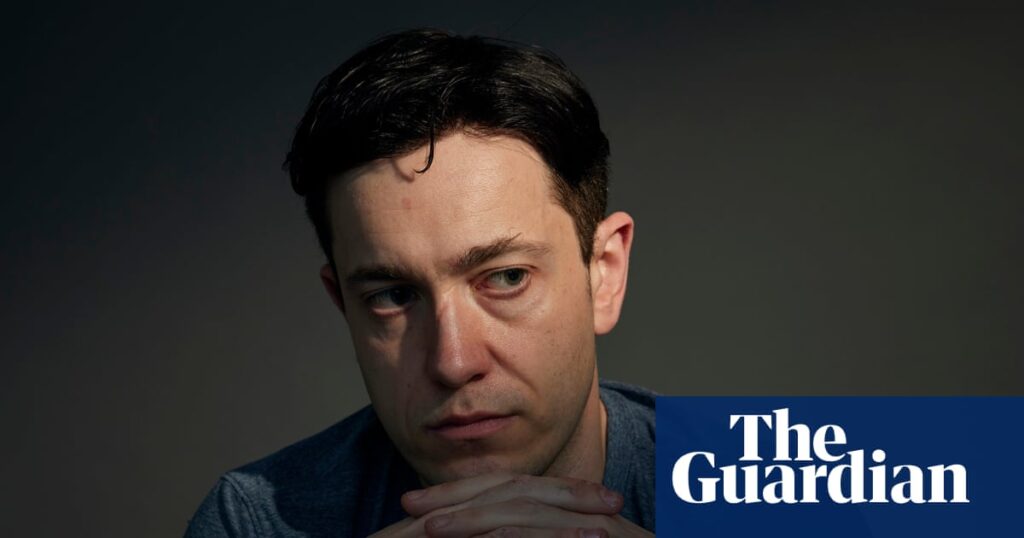

If some time in an entirely possible future they come to make a movie about “how the AI bubble burst”, Ed Zitron will doubtless be a main character. He’s the perfect outsider figure: the eccentric loner who saw all this coming and screamed from the sidelines that the sky was falling, but nobody would listen. Just as Christian Bale portrayed Michael Burry, the investor who predicted the 2008 financial crash, in The Big Short, you can well imagine Robert Pattinson fighting Paul Mescal, say, to portray Zitron, the animated, colourfully obnoxious but doggedly detail-oriented Brit, who’s become one of big tech’s noisiest critics.
This is not to say the AI bubble will burst, necessarily, but against a tidal wave of AI boosterism, Zitron’s blunt, brash scepticism has made him something of a cult figure. His tech newsletter, Where’s Your Ed At, now has more than 80,000 subscribers; his weekly podcast, Better Offline, is well within the Top 20 on the tech charts; he’s a regular dissenting voice in the media; and his subreddit has become a safe space for AI sceptics, including those within the tech industry itself – one user describes him as “a lighthouse in a storm of insane hypercapitalist bullshit”.
Zitron first started looking into generative AI in 2023, a year after the industry-shaking launch of OpenAI’s ChatGPT. “The more I looked, the more confused I became, because on top of the fact that large language models (LLMs) very clearly did not do the things that people were excited about, they didn’t have any path to doing them either,” he says. “Nothing I found made any suggestion that this was a real business at all, let alone something that would supposedly change the world.”
He’s talking over videocall from his office in Las Vegas, dressed in a red hoodie, surrounded by framed pop-culture prints and American sports memorabilia. And boy can Zitron talk. As listeners to Better Offline will know, the 39-year-old is a prodigious speaker – adept at extended monologues, putting his point of view across in accessible, often cheeky language, peppered with facts, statistics, analogies and a fair few expletives, in a London accent that only accentuates his position as a Silicon Valley contrarian – someone who drops his Ts when he says “datacentres”.
Explaining Zitron’s thesis about why generative AI is doomed to fail is not simple: last year he wrote a 19,000-word essay, laying it out. But you could break it down into two, interrelated parts. One is the actual efficacy of the technology; the other is the financial architecture of the AI boom. In Zitron’s view, the foundations are shaky in both cases.
First, there’s the matter of generative AI doing what it’s promised to do. Over the past few years we have had escalating prophecies of the technology laying waste to work as we know it. Dario Amodei, the CEO of Anthropic – OpenAI’s closest rival – warned in May last year that AI could wipe out half of all…
Source link
Disclaimer
We strive to uphold the highest ethical standards in all of our reporting and coverage. We blogs.grocliq.com want to be transparent with our readers about any potential conflicts of interest that may arise in our work. It’s possible that some of the investors we feature may have connections to other businesses, including competitors or companies we write about. However, we want to assure our readers that this will not have any impact on the integrity or impartiality of our reporting. We are committed to delivering accurate, unbiased news and information to our audience, and we will continue to uphold our ethics and principles in all of our work. Thank you for your trust and support.
Website Upgradation is going on for any glitch kindly connect at [email protected]