

A new multi-stage phishing campaign has been observed targeting users in Russia with ransomware and a remote access trojan called Amnesia RAT.
“The attack begins with social engineering lures delivered via business-themed documents crafted to appear routine and benign,” Fortinet FortiGuard Labs researcher Cara Lin said in a technical breakdown published this week. “These documents and accompanying scripts serve as visual distractions, diverting victims to fake tasks or status messages while malicious activity runs silently in the background.”
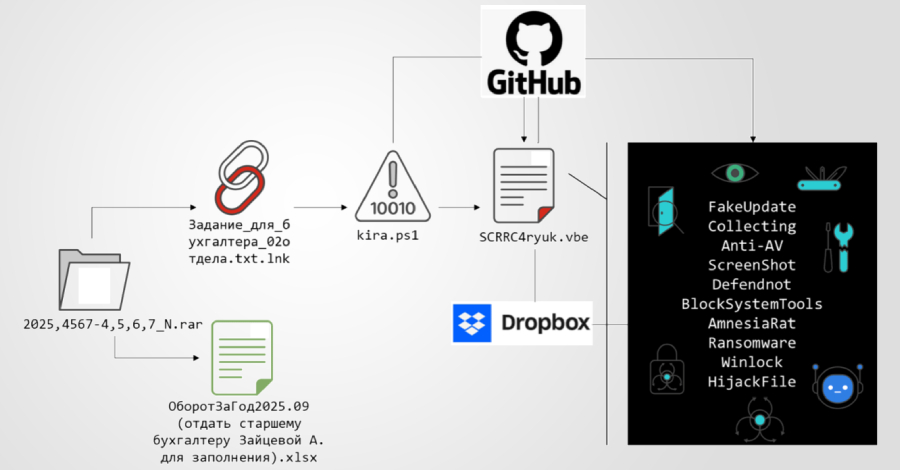
The campaign stands out for a couple of reasons. First, it uses multiple public cloud services to distribute different kinds of payloads. While GitHub is mainly used to distribute scripts, binary payloads are staged on Dropbox. This separation complicates takedown efforts, effectively improving resilience.
Another “defining characteristic” of the campaign, per Fortinet, is the operational abuse of defendnot to disable Microsoft Defender. Defendnot was released last year by a security researcher who goes by the online alias es3n1n as a way to trick the security program into believing another antivirus product has already installed on the Windows host.
The campaign leverages social engineering to distribute compressed archives, which contain multiple decoy documents and a malicious Windows shortcut (LNK) with Russian-language filenames. The LNK file uses a double extension (“Задание_для_бухгалтера_02отдела.txt.lnk”) to give the impression that it’s a text file.
When executed, it runs a PowerShell command to retrieve the next-stage PowerShell script hosted on a GitHub repository (“github[.]com/Mafin111/MafinREP111”), which then serves as a first-stage loader to establish a foothold, readies the system to hide evidence of malicious activity, and hands off control flow to subsequent stages.
“The script first suppresses visible execution by programmatically hiding the PowerShell console window,” Fortinet said. “This removes any immediate visual indicators that a script is running. It then generates a decoy text document in the user’s local application data directory. Once written to disk, the decoy document is automatically opened.”
Once the document is displayed to the victim to keep up the ruse, the script sends a message to the attacker using the Telegram Bot API, informing the operator that the first stage has been successfully executed. A deliberately-introduced 444 second delay later, the PowerShell script runs a Visual Basic Script (“SCRRC4ryuk.vbe”) hosted at the same repository location.
This offers two crucial advantages in that it keeps the loader lightweight and allows the threat actors to update or replace the payload’s functionality on the fly without having to introduce any changes to the attack chain itself.

The Visual Basic Script is highly obfuscated and acts as the controller that assembles the next-stage payload directly in memory, thereby avoiding leaving any…
Source link
Disclaimer
We strive to uphold the highest ethical standards in all of our reporting and coverage. We blogs.grocliq.com want to be transparent with our readers about any potential conflicts of interest that may arise in our work. It’s possible that some of the investors we feature may have connections to other businesses, including competitors or companies we write about. However, we want to assure our readers that this will not have any impact on the integrity or impartiality of our reporting. We are committed to delivering accurate, unbiased news and information to our audience, and we will continue to uphold our ethics and principles in all of our work. Thank you for your trust and support.
Website Upgradation is going on for any glitch kindly connect at [email protected]