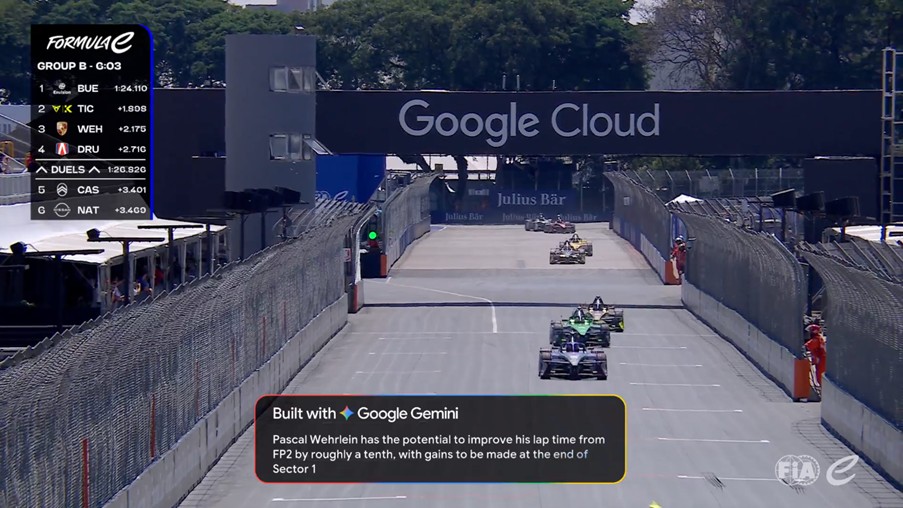

Formula E is using Google Cloud AI to meet its net zero targets by driving efficiency across its global logistics and commercial operations. As part of an expanded multi-year agreement, the electric racing series will integrate Gemini models into its ecosystem to support performance analysis, back-office workflows, and event logistics.
The collaboration demonstrates how sports organisations are utilising cloud infrastructure to drive tangible business outcomes, rather than just securing surface-level sponsorship. The partnership focuses on optimising business operations, ranging from race management to the fan experience.
Operational twins and carbon data to achieve net zero targets
While marketing visibility often drives sports partnerships, this agreement builds on a technical foundation first formalised in January 2025. The elevation to “Principal Partner” involves Formula E adopting Google Cloud technologies for business-critical functions.
The immediate application involves optimising the complex logistics of a global championship. Advanced AI modelling of the back office and the creation of race and event digital twins allow the organisation to simulate and optimise site builds virtually.
This application directly affects Scope 3 emissions. The capability to plan infrastructure virtually minimises the need for physical on-site reconnaissance and reduces the transport of heavy equipment.
For a championship that is the only sport-certified net zero carbon entity since inception, maintaining this status requires finding efficiencies in the supply chain. The digital twin approach delivers a quantifiable reduction in the operational carbon footprint while maintaining performance.
Beyond logistical modelling, the Google Cloud AI partnership extends into the workforce productivity layer. Formula E is deploying Google Workspace with Gemini AI to enable greater agility and efficiency across its organisation.
The organisation intends to use these tools to accelerate performance and deliver faster operations. This reflects a broader trend where generative AI tools are provisioned to reduce administrative latency in distributed workforces.
The viability of these implementations to achieve net zero targets is supported by previous collaborative projects. Formula E recently utilised Google’s AI Studio and Gemini models to execute the ‘Mountain Recharge’ initiative.
Engineers used the models to map an optimal route for the GENBETA car during a mountain descent. The AI identified and analysed specific braking zones, calculating the necessary regenerative braking required to harvest enough energy to complete a full lap of the Monaco circuit subsequently.
This specific use case demonstrates how high-dimensional data – including topography, friction, and energy consumption – can be processed to define physical execution.
Using Google Cloud AI to enhance Formula E’s data product
The partnership also addresses the commercial requirement to retain and…
Source link
Disclaimer
We strive to uphold the highest ethical standards in all of our reporting and coverage. We blogs.grocliq.com want to be transparent with our readers about any potential conflicts of interest that may arise in our work. It’s possible that some of the investors we feature may have connections to other businesses, including competitors or companies we write about. However, we want to assure our readers that this will not have any impact on the integrity or impartiality of our reporting. We are committed to delivering accurate, unbiased news and information to our audience, and we will continue to uphold our ethics and principles in all of our work. Thank you for your trust and support.
Website Upgradation is going on for any glitch kindly connect at [email protected]