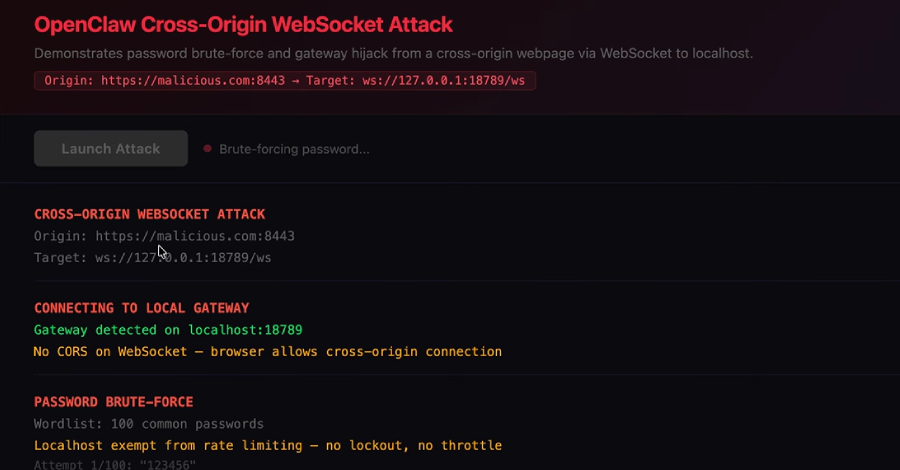


OpenClaw has fixed a high-severity security issue that, if successfully exploited, could have allowed a malicious website to connect to a locally running artificial intelligence (AI) agent and take over control.
“Our vulnerability lives in the core system itself – no plugins, no marketplace, no user-installed extensions – just the bare OpenClaw gateway, running exactly as documented,” Oasis Security said in a report published this week.
The flaw has been codenamed ClawJacked by the cybersecurity company.
The attack assumes the following threat model: A developer has OpenClaw set up and running on their laptop, with its gateway, a local WebSocket server, bound to localhost and protected by a password. The attack kicks in when the developer lands on an attacker-controlled website through social engineering or some other means.
The infection sequence then follows the steps below –
- Malicious JavaScript on the web page opens a WebSocket connection to localhost on the OpenClaw gateway port.
- The script brute-forces the gateway password by taking advantage of a missing rate-limiting mechanism.
- Post successful authentication with admin-level permissions, the script stealthily registers as a trusted device, which is auto-approved by the gateway without any user prompt.
- The attacker gains complete control over the AI agent, allowing them to interact with it, dump configuration data, enumerate connected nodes, and read application logs.
“Any website you visit can open one to your localhost. Unlike regular HTTP requests, the browser doesn’t block these cross-origin connections,” Oasis Security said. “So while you’re browsing any website, JavaScript running on that page can silently open a connection to your local OpenClaw gateway. The user sees nothing.”
“That misplaced trust has real consequences. The gateway relaxes several security mechanisms for local connections – including silently approving new device registrations without prompting the user. Normally, when a new device connects, the user must confirm the pairing. From localhost, it’s automatic.”
Following responsible disclosure, OpenClaw pushed a fix in less than 24 hours with version 2026.2.25 released on February 26, 2026. Users are advised to apply the latest updates as soon as possible, periodically audit access granted to AI agents, and enforce appropriate governance controls for non-human (aka agentic) identities.
The development comes amid a broader security scrutiny of the OpenClaw ecosystem, primarily stemming from the fact that AI agents hold entrenched access to disparate systems and the authority to execute tasks across enterprise tools, leading to a significantly larger blast radius should they be compromised.
Reports from Bitsight and NeuralTrust have detailed how OpenClaw instances left connected to the internet pose an expanded attack surface, with each integrated service further broadening the blast radius and can be transformed into an attack weapon by embedding prompt…
Source link
Disclaimer
We strive to uphold the highest ethical standards in all of our reporting and coverage. We blogs.grocliq.com want to be transparent with our readers about any potential conflicts of interest that may arise in our work. It’s possible that some of the investors we feature may have connections to other businesses, including competitors or companies we write about. However, we want to assure our readers that this will not have any impact on the integrity or impartiality of our reporting. We are committed to delivering accurate, unbiased news and information to our audience, and we will continue to uphold our ethics and principles in all of our work. Thank you for your trust and support.
Website Upgradation is going on for any glitch kindly connect at [email protected]