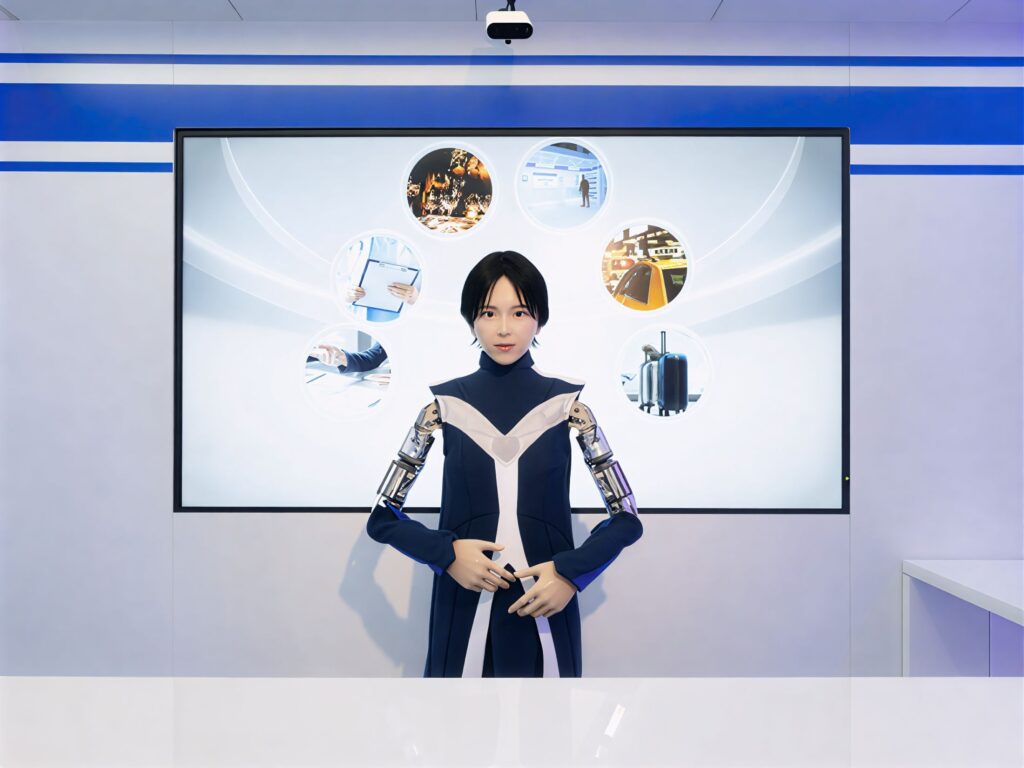

The adoption of physical AI drives ROI in frontline customer service by merging digital intelligence with human-like physical interaction.
As businesses navigate shrinking labour pools, they are finding that simply automating routine workflows is no longer enough. A new partnership between KDDI and AVITA demonstrates how companies can address complex operational gaps through humanoid deployment.
While traditional industrial robots excel at repetitive, single-function tasks, they lack the versatility required to manage unexpected anomalies like equipment failures. Customer-facing roles demand nonverbal communication, including synchronised nodding, natural eye contact, and reassuring facial expressions.
By integrating AVITA’s avatar creation expertise with KDDI’s communications infrastructure, the two organisations are building domestically developed humanoids capable of operating smoothly in real-world commercial environments.
Blending hardware with advanced data infrastructure
Deploying humanoids into active commercial spaces requires high-capacity and low-latency network infrastructure to transmit visual data and control commands in real time. KDDI provides this operational backbone, facilitating remote control capabilities alongside intensive cloud-based data processing. The resulting visual and motion data collected during customer interactions feeds back into the system to train the AI, improving the precision and autonomy of the humanoid’s behaviour.
To support the demanding computational requirements of physical AI adoption, the companies plan to utilise GPUs hosted at the Osaka Sakai Data Center, which commenced operations in January 2026. They are also exploring integration with an on-premises service for Google’s Gemini high-performance generative AI model. This alignment with major enterprise platforms ensures that data processing remains secure and capable of handling complex dialogue requirements.
The hardware itself departs from standard utilitarian machinery. Based on a concept model designed by Hiroshi Ishiguro, the humanoid features a compact skeletal structure approximating a typical Japanese physique.
Silicone skin and specialised mechanical systems enable warm, approachable facial expressions that sync directly with spoken dialogue. Embedded camera sensors track objects in motion to create natural eye contact, while quiet pneumatic actuation allows for fluid and continuous movement with natural “micro-variations”. This design specifically addresses the historical difficulty of deploying automation in operations requiring hospitality and reassurance.
Preparing for commercial adoption of physical AI
This initiative builds upon earlier joint projects between KDDI and AVITA, which introduced a “next-generation remote customer service platform” using digital avatars for remote assistance at retail locations like Lawson and au Style shops.
Transitioning from…
Source link
Disclaimer
We strive to uphold the highest ethical standards in all of our reporting and coverage. We blogs.grocliq.com want to be transparent with our readers about any potential conflicts of interest that may arise in our work. It’s possible that some of the investors we feature may have connections to other businesses, including competitors or companies we write about. However, we want to assure our readers that this will not have any impact on the integrity or impartiality of our reporting. We are committed to delivering accurate, unbiased news and information to our audience, and we will continue to uphold our ethics and principles in all of our work. Thank you for your trust and support.
Website Upgradation is going on for any glitch kindly connect at [email protected]