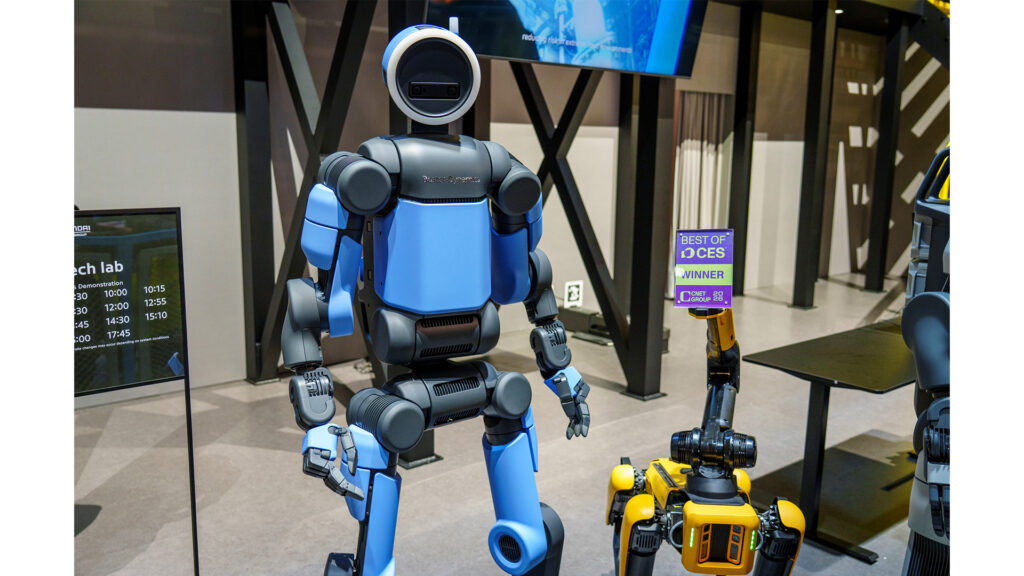

There is a particular kind of momentum in the technology industry that announces itself not through a single breakthrough, but through the simultaneous convergence of many. Physical AI is having that moment right now–and paying attention to where it is coming from, and why, tells you more than any single product launch can.
The term itself–physical AI–is simple enough. It describes AI systems that don’t just process data or generate content, but perceive, reason, and act in the real world–robots, autonomous vehicles, machines that adapt. Nvidia CEO Jensen Huang called it “the ChatGPT moment for robotics” at CES in January–a deliberate framing, and a useful one.
The ChatGPT comparison isn’t about hype. It signals that a technology once confined to research environments is being adopted for mainstream commercial deployment. That crossing is exactly what we are watching unfold from factory floors in Silicon Valley to stages in Shanghai.”
The West is building the stack
On the Western side, the physical AI push is fundamentally a platform race. The companies investing most aggressively aren’t primarily robotics companies–they’re infrastructure companies that see robotics as the next surface on which AI gets monetised.
Nvidia has released new Cosmos and GR00T open models for robot learning and reasoning, alongside the Blackwell-powered Jetson T4000 module, which delivers 4x greater energy efficiency for robotics computing. Arm has carved outan entirely new Physical AI business unit focused on semiconductor design for robotics and intelligent vehicles.
Siemens and Nvidia announced plans to build what they’re calling an Industrial AI Operating System, with ambitions to create the world’s first fully AI-driven adaptive manufacturing site. Then there’s Google, which last week brought its robotics software unit Intrinsic fully in-house–out of Alphabet’s “Other Bets” and into Google’s core.
The move positions Google to offer manufacturers a vertically integrated stack: AI models from DeepMind, deployment software from Intrinsic, and cloud infrastructure from Google Cloud. The Android analogy being floated internally is instructive. Android didn’t win smartphones by building the best phone. It won by becoming the layer everything else ran on.
That is precisely what Google is attempting with physical AI.
The enterprise implications are significant. A Deloitte survey of more than 3,200 global business leaders found that 58% are already using physical AI in some capacity, rising to 80% with plans over the next two years. The demand is there. The question has shifted from whether to adopt to how fast and on whose platform.
The East is building the machines
China’s physical AI story is different in character–and arguably more visceral. At this year’s Spring Festival Gala, humanoid robots from multiple Chinese startups performed kung fu routines, aerial flips, and choreographed dances before hundreds of…
Source link
Disclaimer
We strive to uphold the highest ethical standards in all of our reporting and coverage. We blogs.grocliq.com want to be transparent with our readers about any potential conflicts of interest that may arise in our work. It’s possible that some of the investors we feature may have connections to other businesses, including competitors or companies we write about. However, we want to assure our readers that this will not have any impact on the integrity or impartiality of our reporting. We are committed to delivering accurate, unbiased news and information to our audience, and we will continue to uphold our ethics and principles in all of our work. Thank you for your trust and support.
Website Upgradation is going on for any glitch kindly connect at [email protected]