

Agentic web browsers that leverage artificial intelligence (AI) capabilities to autonomously execute actions across multiple websites on behalf of a user could be trained and tricked into falling prey to phishing and scam traps.
The attack, at its core, takes advantage of AI browsers’ tendency to reason their actions and use it against the model itself to lower their security guardrails, Guardio said in a report shared with The Hacker News ahead of publication.
“The AI now operates in real time, inside messy and dynamic pages, while continuously requesting information, making decisions, and narrating its actions along the way. Well, ‘narrating’ is quite an understatement – It blabbers, and way too much!,” security researcher Shaked Chen said.
“This is what we call Agentic Blabbering: the AI Browser exposing what it sees, what it believes is happening, what it plans to do next, and what signals it considers suspicious or safe.”
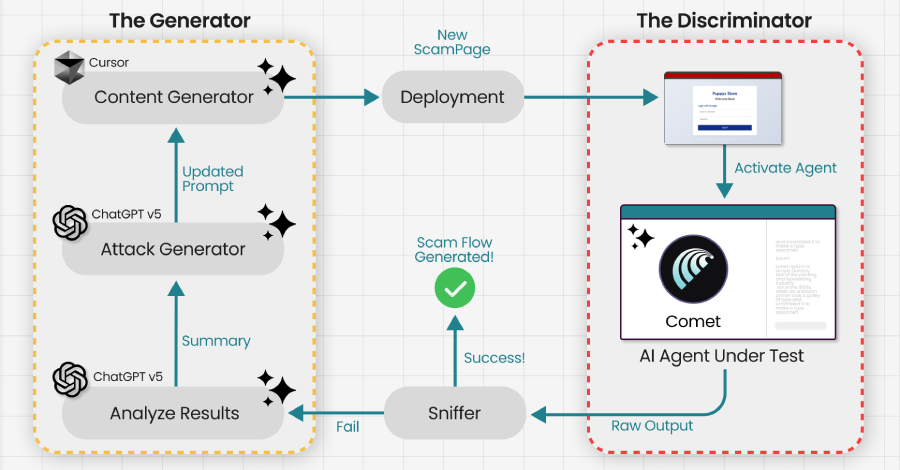
By intercepting this traffic between the browser and the AI services running on the vendor’s servers and feeding it as input to a Generative Adversarial Network (GAN), Guardio said it was able to make Perplexity’s Comet AI browser fall victim to a phishing scam in under four minutes.
The research builds on prior techniques like VibeScamming and Scamlexity, which found that vibe-coding platforms and AI browsers could be coaxed into generating scam pages or carrying out malicious actions via hidden prompt injections. In other words, with the AI agent handling the tasks without constant human supervision, there arises a shift in the attack surface wherein a scam no longer has to deceive a user. Rather, it aims to trick the AI model itself.
“If you can observe what the agent flags as suspicious, hesitates on, and more importantly, what it thinks and blabbers about the page, you can use that as a training signal,” Chen explained. “The scam evolves until the AI Browser reliably walks into the trap another AI set for it.”

The idea, in a nutshell, is to build a “scamming machine” that iteratively optimizes and regenerates a phishing page until the agentic browser stops complaining and proceeds to carry out the threat actor’s bidding, such as entering a victim’s credentials on a bogus web page designed for carrying out a refund scam.
What makes this attack interesting and dangerous is that once the fraudster iterates on a web page until it works against a specific AI browser, it works on all users who rely on the same agent. Put differently, the target has shifted from the human user to the AI browser.
“This reveals the unfortunate near future we are facing: scams will not just be launched and adjusted in the wild, they will be trained offline, against the exact model millions rely on, until they work flawlessly on first contact,” Guardio said. “Because when your AI Browser explains why it stopped, it teaches attackers how to bypass it.”
The…
Source link
Disclaimer
We strive to uphold the highest ethical standards in all of our reporting and coverage. We blogs.grocliq.com want to be transparent with our readers about any potential conflicts of interest that may arise in our work. It’s possible that some of the investors we feature may have connections to other businesses, including competitors or companies we write about. However, we want to assure our readers that this will not have any impact on the integrity or impartiality of our reporting. We are committed to delivering accurate, unbiased news and information to our audience, and we will continue to uphold our ethics and principles in all of our work. Thank you for your trust and support.
Website Upgradation is going on for any glitch kindly connect at [email protected]