
When Romy Gai, FIFA’s chief business officer, described the operational challenge of running a 48-team World Cup across Canada, Mexico and the United States, he was not talking about technology. He was talking about complexity.
Previous World Cups relied on local organising committees to absorb much of the logistical load. For 2026, FIFA is running operations directly. Six billion people are expected to watch. There are 104 matches, up from 64 in Qatar. There are 48 teams instead of 32, 180-plus broadcasters, and no single national infrastructure to lean on. The scale is genuinely new.
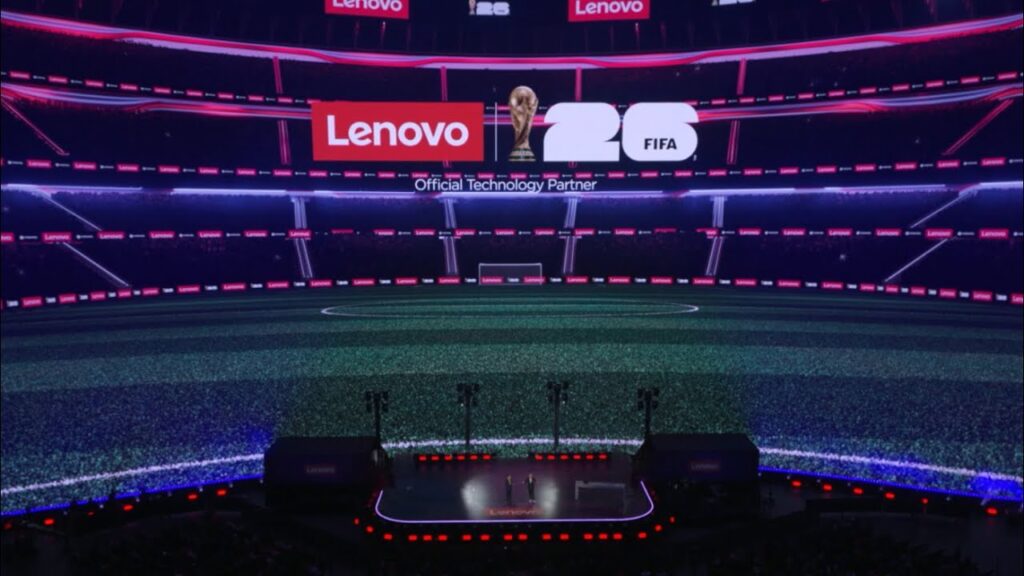
The AI strategy FIFA unveiled at Lenovo Tech World in Hong Kong this week is best understood against that backdrop. Football AI Pro, AI-enabled 3D player avatars, and a next-generation Referee View are the headline announcements. Butthe product decisions themselves reflect something more structural: an organisation that has decided AI is not an enhancement to how it runs football’s biggest event, but it is how the event gets run.
Football AI Pro is a generative AI knowledge assistant that will be made available to all 48 teams competing at the 2026 World Cup. It is built on FIFA’s Football Language Model and trained on hundreds of millions of FIFA-owned data points. It generates pre- and post-match analysis in text, video, graphs and 3D visualisations, supports prompts in multiple languages, and will not be used during live play.
The democratisation argument behind it is straightforward. At the highest level of the game, access to sophisticated match analysis depends heavily on a team’s financial resources. A tier-one footballing nation has a dedicated analytics department. A team competing at its first World Cup does not. Football AI Pro is designed to give every team the same analytical baseline.
That ambition is real, but it is also worth understanding as an enterprise AI deployment challenge. Delivering consistent, tournament-wide intelligence across 48 teams in three countries, in multiple languages, against a match schedule that runs for weeks, is not a small infrastructure problem. It is the kind of workload that requires exactly the hybrid AI architecture
Lenovo has been building its enterprise positioning.
The referee camera is about transparency, not television
The updated Referee View is being framed in broadcast terms, and it will look good on screen. AI-powered stabilisation smooths footage captured from the referee’s body camera in real time, reducing the motion blur that made the original version hard to watch during fast play.
The more significant purpose is transparency. VAR has been one of the most contested technologies in…
Source link
Disclaimer
We strive to uphold the highest ethical standards in all of our reporting and coverage. We blogs.grocliq.com want to be transparent with our readers about any potential conflicts of interest that may arise in our work. It’s possible that some of the investors we feature may have connections to other businesses, including competitors or companies we write about. However, we want to assure our readers that this will not have any impact on the integrity or impartiality of our reporting. We are committed to delivering accurate, unbiased news and information to our audience, and we will continue to uphold our ethics and principles in all of our work. Thank you for your trust and support.
Website Upgradation is going on for any glitch kindly connect at [email protected]