

The most dangerous phishing campaigns aren’t just designed to fool employees. Many are designed to exhaust the analysts investigating them. When a phishing investigation takes 12 hours instead of five minutes, the outcome can shift from a contained incident to a breach.
For years, the cybersecurity industry has focused on the front door of phishing defense: employee training, email gateways that filter known threats, and reporting programs that encourage users to flag suspicious messages. Far less attention has been paid to what happens after a report is filed, and how attackers exploit the investigation process that follows.
Alert fatigue in Security Operations Centers isn’t just an operational inconvenience. It can become an attack surface. SOC teams increasingly report phishing campaigns that appear designed not only to compromise targets but also to overwhelm the analysts responsible for investigating them.
This shifts how organizations should think about phishing defense. The vulnerability isn’t just the employee who clicks. It’s also the analyst who can’t keep up with the queue. When investigations that should close in minutes stretch to 3, 6, or 12 hours because of queue congestion, the window for attacker success widens dramatically.
When Phishing Volume Becomes a Weapon
Phishing is often treated as a series of independent threats. One message. One potential victim. One investigation. Attackers operating at scale think in terms of systems, not individual messages. A SOC is one of those systems, and it has finite capacity and predictable failure modes.
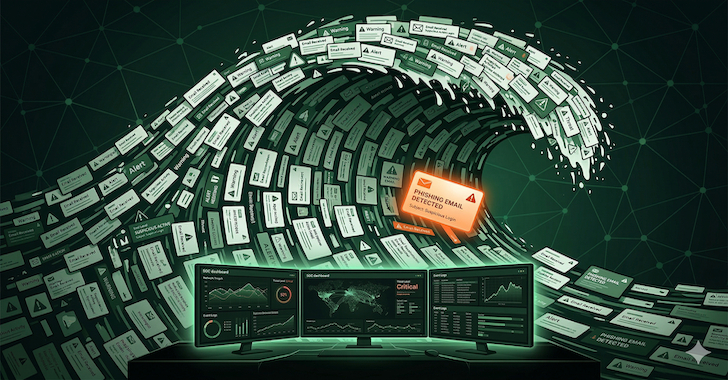
Consider a phishing campaign targeting a large enterprise. The attacker sends thousands of messages. Most are low-sophistication lures that email gateways or trained employees will likely catch. These messages flood the SOC with reports and alerts. Analysts begin triaging, working through a queue that grows faster than they can clear it.
Buried in that volume are a few carefully crafted spear-phishing messages targeting individuals with access to critical systems. These messages are the real payload. The flood is not just a numbers game. It is effectively a denial-of-service attack against the SOC’s attention, sometimes referred to as an Informational Denial-of-Service (IDoS).
This pattern is not purely theoretical. Red team exercises and incident reports have documented adversaries who time high-volume phishing campaigns to coincide with targeted spear-phishing attempts. The commodity wave creates noise. The targeted message hides inside it.
The Predictable Failure Mode
This tactic works because SOC phishing triage tends to follow a predictable pattern across organizations. When phishing report volume spikes, most SOCs respond in predictable ways. Analysts begin triaging faster, spending less time per submission. Investigation depth decreases. Industry research shows 66% of SOC teams cannot keep up with incoming alerts. The focus shifts from thorough investigation to clearing…
Source link
Disclaimer
We strive to uphold the highest ethical standards in all of our reporting and coverage. We blogs.grocliq.com want to be transparent with our readers about any potential conflicts of interest that may arise in our work. It’s possible that some of the investors we feature may have connections to other businesses, including competitors or companies we write about. However, we want to assure our readers that this will not have any impact on the integrity or impartiality of our reporting. We are committed to delivering accurate, unbiased news and information to our audience, and we will continue to uphold our ethics and principles in all of our work. Thank you for your trust and support.
Website Upgradation is going on for any glitch kindly connect at [email protected]