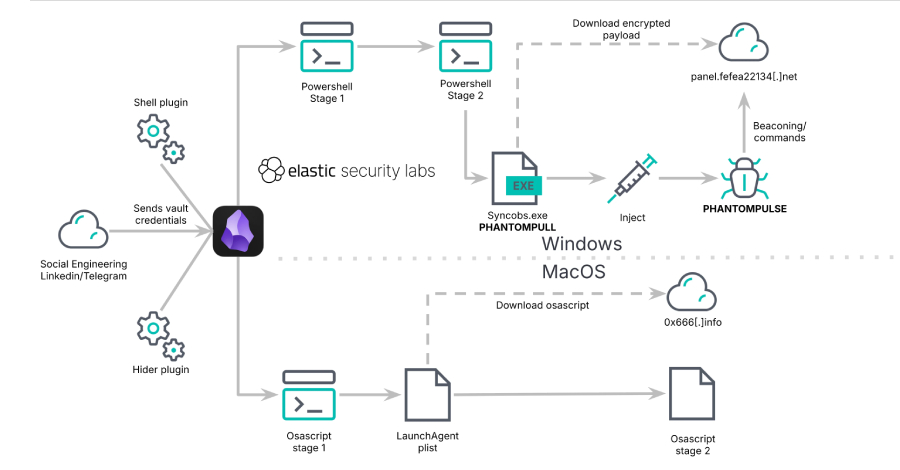


A “novel” social engineering campaign has been observed abusing Obsidian, a cross-platform note-taking application, as an initial access vector to distribute a previously undocumented Windows remote access trojan called PHANTOMPULSE in attacks targeting individuals in the financial and cryptocurrency sectors.
Dubbed REF6598 by Elastic Security Labs, the activity has been found to leverage elaborate social engineering tactics through LinkedIn and Telegram to breach both Windows and macOS systems, approaching prospective individuals under the guise of a venture capital firm and then moving the conversation to a Telegram group where several purported partners are present.
The Telegram group chat is engineered to lend the operation a smidgen of credibility, with the members discussing topics related to financial services and cryptocurrency liquidity solutions. The target is then instructed to use Obsidian to access what appears to be a shared dashboard by connecting to a cloud-hosted vault using the credentials provided to them.
It’s this vault that triggers the infection sequence. As soon as the vault is opened in the note-taking application, the target is asked to enable “Installed community plugins” sync, effectively causing malicious code to be executed.
“The threat actors abuse Obsidian’s legitimate community plugin ecosystem, specifically the Shell Commands and Hider plugins, to silently execute code when a victim opens a shared cloud vault,” researchers Salim Bitam, Samir Bousseaden, and Daniel Stepanic said in a technical breakdown of the campaign.
Given that the option is disabled by default and cannot be remotely turned on, the attacker must convince the target to manually toggle the community plugin sync on their device so that the malicious vault configuration can trigger the execution of commands through the Shell Commands plugin. Also used in conjunction with Shell Commands is another plugin named Hider to hide certain user interface elements of Obsidian, such as status bar, scrollbar, tooltips, and others.
“While this attack requires social engineering to cross the community plugin sync boundary, the technique remains notable: it abuses a legitimate application feature as a persistence and command execution channel, the payload lives entirely within JSON configuration files that are unlikely to trigger traditional AV [antivirus] signatures, and execution is handed off by a signed, trusted Electron application, making parent-process-based detection the critical layer,” the researchers said.
Dedicated execution paths are activated depending on the operating system. On Windows, the commands are used to invoke a PowerShell script to drop an intermediate loader codenamed PHANTOMPULL that decrypts and launches PHANTOMPULSE in memory.
PHANTOMPULSE is an artificial intelligence (AI)-generated backdoor that uses the Ethereum blockchain for…
Source link
Disclaimer
We strive to uphold the highest ethical standards in all of our reporting and coverage. We blogs.grocliq.com want to be transparent with our readers about any potential conflicts of interest that may arise in our work. It’s possible that some of the investors we feature may have connections to other businesses, including competitors or companies we write about. However, we want to assure our readers that this will not have any impact on the integrity or impartiality of our reporting. We are committed to delivering accurate, unbiased news and information to our audience, and we will continue to uphold our ethics and principles in all of our work. Thank you for your trust and support.
Website Upgradation is going on for any glitch kindly connect at [email protected]