

Cybersecurity researchers have discovered a vulnerability in Google’s agentic integrated development environment (IDE), Antigravity, that could be exploited to achieve code execution.
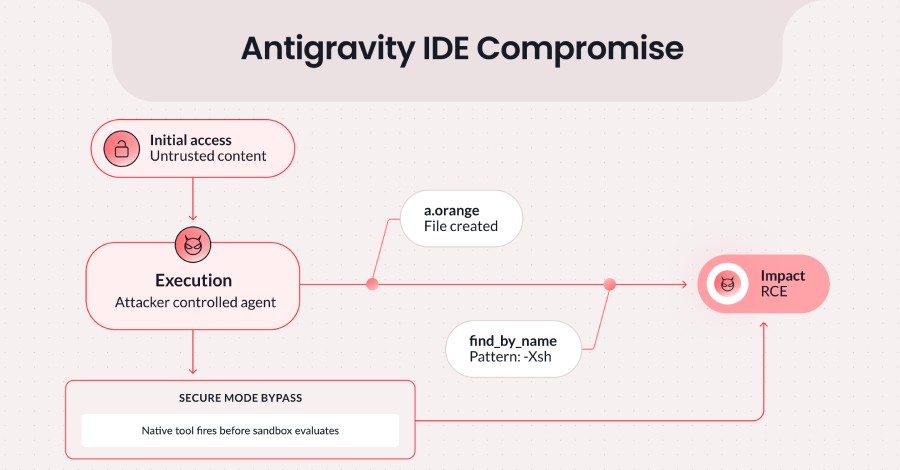
The flaw, since patched, combines Antigravity’s permitted file-creation capabilities with an insufficient input sanitization in Antigravity’s native file-searching tool, find_by_name, to bypass the program’s Strict Mode, a restrictive security configuration that limits network access, prevents out-of-workspace writes, and ensures all commands are being run within a sandbox context.
“By injecting the -X (exec-batch) flag through the Pattern parameter [in the find_by_name tool], an attacker can force fd to execute arbitrary binaries against workspace files,” Pillar Security researcher Dan Lisichkin said in an analysis.
“Combined with Antigravity’s ability to create files as a permitted action, this enables a full attack chain: stage a malicious script, then trigger it through a seemingly legitimate search, all without additional user interaction once the prompt injection lands.”
The attack takes advantage of the fact that the find_by_name tool call is executed before any of the constraints associated with Strict Mode are enforced and is instead interpreted as a native tool invocation, leading to arbitrary code execution. While the Pattern parameter is designed to accept a filename search pattern to trigger a file and directory search using fd through find_by_name, it’s undermined by a lack of strict validation, passing the input directly to the underlying fd command.
An attacker could, therefore, leverage this behavior to stage a malicious file and inject malicious commands into the Pattern parameter to trigger the execution of the payload.
“The critical flag here is -X (exec-batch). When passed to fd, this flag executes a specified binary against each matched file,” Pillar explained. “By crafting a Pattern value of -Xsh, an attacker causes fd to pass matched files to sh for execution as shell scripts.”
Alternatively, the attack can be initiated via an indirect prompt injection without having to compromise a user’s account. In this approach, an unsuspecting user pulls a seemingly harmless file from an untrusted source that contains hidden attacker-controlled comments instructing the artificial intelligence (AI) agent to stage and trigger the exploit.
Following responsible disclosure on January 7, 2026, Google addressed the shortcoming as of February 28.
“Tools designed for constrained operations become attack vectors when their inputs are not strictly validated,” Lisichkin said. “The trust model underpinning security assumptions, that a human will catch something suspicious, does not hold when autonomous agents follow instructions from external content.”
The findings coincide with the discovery of a number of now-patched security flaws in various AI-powered tools –
- Anthropic Claude Code…
Source link
Disclaimer
We strive to uphold the highest ethical standards in all of our reporting and coverage. We blogs.grocliq.com want to be transparent with our readers about any potential conflicts of interest that may arise in our work. It’s possible that some of the investors we feature may have connections to other businesses, including competitors or companies we write about. However, we want to assure our readers that this will not have any impact on the integrity or impartiality of our reporting. We are committed to delivering accurate, unbiased news and information to our audience, and we will continue to uphold our ethics and principles in all of our work. Thank you for your trust and support.
Website Upgradation is going on for any glitch kindly connect at [email protected]