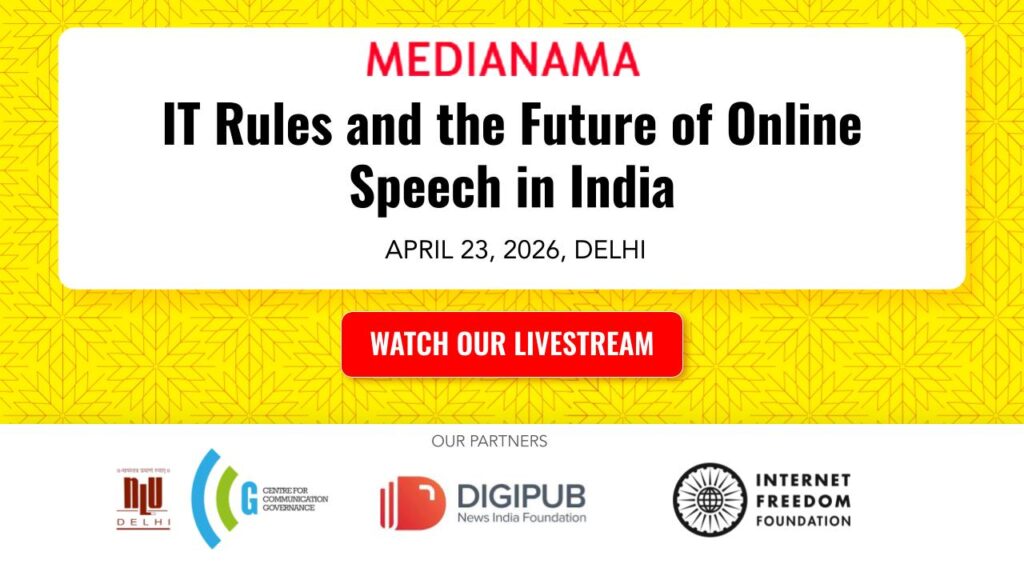

Missed registering for the discussion? No problem. You can watch it live on MediaNama’s YouTube channel now, or catch up at your convenience using the link below:
We’ve confirmed over 100+ attendees and a stellar speaker line-up.
Speakers and agenda:
1:00 PM – 1:45 PM | Session 1: Victims of Censorship in India (in partnership with DIGI Pub)
- Moderator: Adrija Bose, Editor, Decode Internet
- Neeraj Jha, Chief Editor, Molitics
- Haseen Rehmani, Bolta Hindustan, Founder
- Ambuj Kumar, Lokhit India, Editor
- Sanjay Sharma, 4-PM, Editor in Chief
10 Minute break
Key questions:
- What does it actually feel like to have content taken down by the government, and what recourse does one have?
- What kinds of content are most at risk under the current takedown regime?
- Is online censorship in India getting worse, and if so, what is driving it?
- How are independent journalists and small digital publishers disproportionately affected by content take down mechanisms compared to larger news organisations?
- How does the threat of content removal affect what journalists and content creators choose to publish in the first place?
- Are takedown orders being used to silence criticism of the government, and what does the evidence show?
1:55 PM – 2:45 PM | Session 2: MeitY’s Expanding Mandate: Rule 3(4), the timelines for content takedowns, and the Safe Harbour, in the context of Shreya Singhal and the IT Act.
- Moderator: Aditi Agarwal, Independent Journalist, Tech Trace
- Rakesh Maheshwari, Former Sr. Director and Group Coordinator, MeitY
- Vasudev Devadasan, Lawyer and Master of Law Candidate at University of Melbourne
- Torsha Sarkar, Project Manager at Centre for Communication Governance, NLU Delhi (CCG-NLUD)
- Snehashish Ghosh, TechNiti
Key Questions:
- What specific compliance gap is Rule 3(4) attempting to address, and does the proposed approach go beyond that stated objective?
- What is the current legal status of MeitY-issued advisories, clarifications, and directions, and how would the amendments change their enforceability?
- By linking safe harbour to compliance with a wide range of executive instruments, does Rule 3(4) effectively convert conditional immunity into a continuous compliance obligation?
- How do these changes interact with the principles established in Shreya Singhal, particularly the requirement of a judicial order for content restriction?
- What operational challenges do platforms face with evolving and potentially unclear compliance requirements, especially when combined with shortened takedown timelines?
- Taken together with existing tools such as Sahyog and reduced response timelines, do these amendments contribute to a broader censorship infrastructure, and what are the implications of that shift?
3:25 PM – 4:15 PM | Session 3: MIB’s Expanded Reach: The IDC, Part III, and Government…
Source link
Disclaimer
We strive to uphold the highest ethical standards in all of our reporting and coverage. We blogs.grocliq.com want to be transparent with our readers about any potential conflicts of interest that may arise in our work. It’s possible that some of the investors we feature may have connections to other businesses, including competitors or companies we write about. However, we want to assure our readers that this will not have any impact on the integrity or impartiality of our reporting. We are committed to delivering accurate, unbiased news and information to our audience, and we will continue to uphold our ethics and principles in all of our work. Thank you for your trust and support.
Website Upgradation is going on for any glitch kindly connect at [email protected]