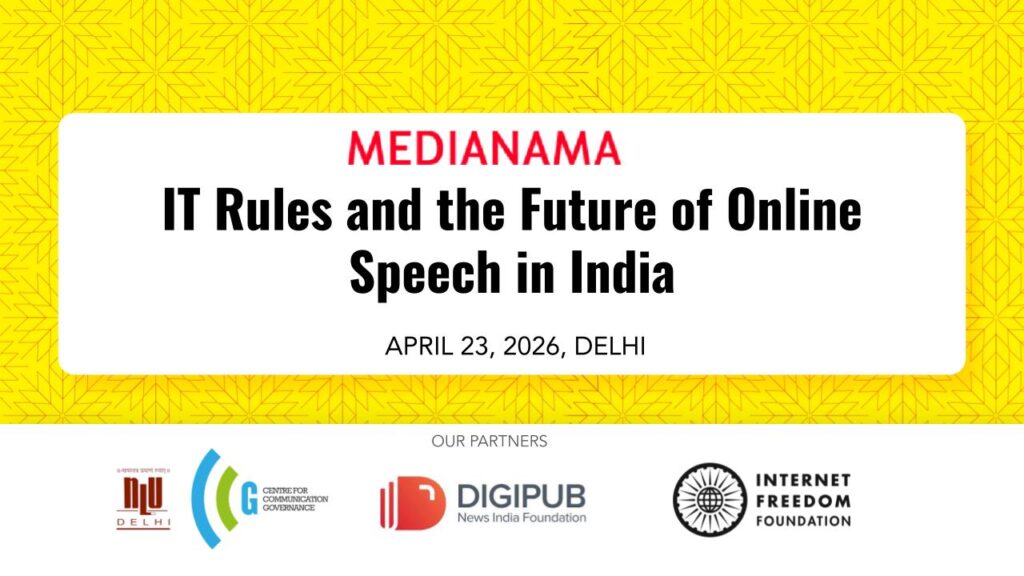

“My whole point of view is that this opacity completely empowers people to censor speech without any restriction whatsoever and without any accountability whatsoever. That is expanding at a scale and pace,” said Nikhil Pahwa, Founder and Editor-in-Chief of MediaNama, during the second session of MediaNama’s discussion on ‘IT Rules and the Future of Online Speech’ in India on April 23 in Delhi.
The panel, titled ‘MeitY’s Expanding Mandate: Rule 3(4), the timelines for content takedowns, and Safe Harbour in the context of Shreya Singhal and the IT Act’, saw panellists discuss the need for greater transparency in India’s online takedown and blocking regime. They highlighted opacity in legal processes, contradictions in confidentiality rules, and proposals for public disclosure of takedown notices.
“No transparency”: Government can block content without explanation
Vasudev Devadasan, Lawyer and Master of Law Candidate at the University of Melbourne, said the current system gives the government wide powers to block content without oversight or transparency.
“The government can, by notification, with no transparency, for almost any content on the internet, block your content, and you don’t know why it’s blocked, you don’t know who to approach,” he said.
Devadasan contrasted this with actions in the physical world, where arrests or business takeovers require judicial oversight. “But with respect to speech, we seem to have accepted that the government can just block speech like this,” he said.
He added that the issue was not limited to isolated posts. “As we’ve heard in the first panel, it’s not individual random posts with three likes only. It’s entire businesses that are being blocked effectively,” he said.
Different confidentiality requirements in Section 69A and 79(3)(b)
Snehashish Ghosh, founder of TechNiti, said transparency could be the “silver bullet” for fixing issues in both Section 69A blocking orders and Section 79(3)(b) takedown notices. Ghosh pointed to a contradiction in the legal framework. He said the Supreme Court’s Shreya Singhal judgment required notice to users in Section 69A proceedings, but Rule 16 of the Blocking Rules imposed strict confidentiality.
“One thing Shreya Singhal did with 69A was to talk about how the notice needs to be given to the user. But at the same time, IT Rules 16 talks about strict confidentiality regarding the request from the company, but the communication, as well as the action taken thereof. So it doesn’t know what to do,” he said.
He noted that Section 79(3)(b) did not contain the same confidentiality requirement. “One interesting piece which is lacking in Section 79(3)(b), and deliberately so, is that there is no strict confidentiality requirement. Therefore, there can be more transparency in terms of the nature and types of requests sent,” he said.
Calls for a public repository of takedown…
Source link
Disclaimer
We strive to uphold the highest ethical standards in all of our reporting and coverage. We blogs.grocliq.com want to be transparent with our readers about any potential conflicts of interest that may arise in our work. It’s possible that some of the investors we feature may have connections to other businesses, including competitors or companies we write about. However, we want to assure our readers that this will not have any impact on the integrity or impartiality of our reporting. We are committed to delivering accurate, unbiased news and information to our audience, and we will continue to uphold our ethics and principles in all of our work. Thank you for your trust and support.
Website Upgradation is going on for any glitch kindly connect at [email protected]