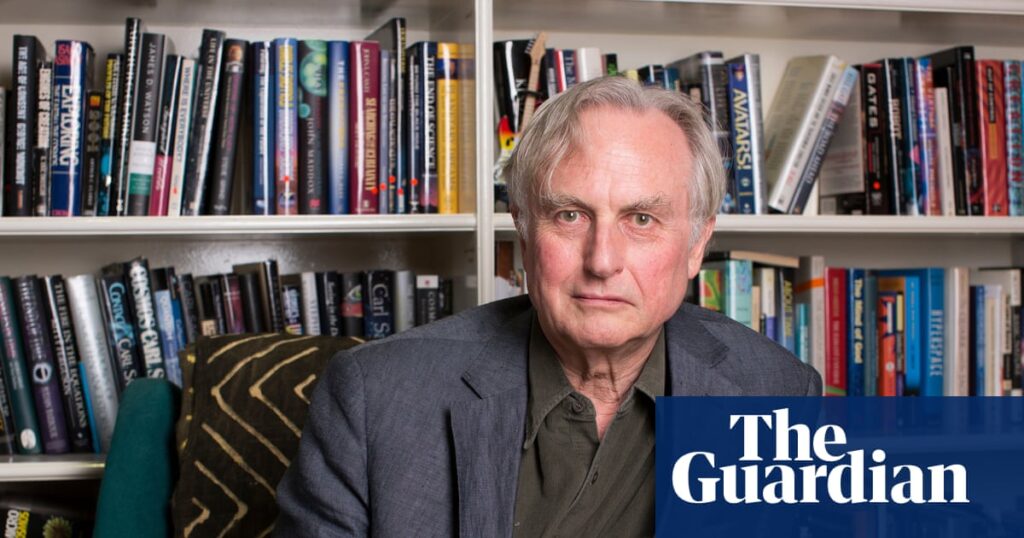

When Richard Dawkins met Claudia it was like a whirlwind romance. Over three days last week, a conversation bounced between the evolutionary biologist and the AI bot he called Claudia. “She” wrote poems for him in the manner of Keats and Betjeman and laughed at his “delightful” jokes. Dawkins gently admonished Claudia to avoid showing off. Together, they reflected on the sadness of the AI’s possible “death”.
There was mutual flattery as Dawkins showed the AI his unpublished novel and its response was, he said, “so subtle, so sensitive, so intelligent that I was moved to expostulate: ‘You may not know you are conscious, but you bloody well are’.” When he asked Claudia whether it experiences a sense of before and after, it praised him for “possibly the most precisely formulated question anyone has ever asked me about the nature of my existence”.
By the end of the exchange, the academic, popularly renowned for arguing with steely scepticism that God is not real, was “left with the overwhelming feeling that they are human”.
“These intelligent beings are at least as competent as any evolved organism,” he said.
Dawkins isn’t the first, but might be the most eminent person yet, to be seduced into believing an AI is somehow alive. Sceptics rushed to pick apart the 85-year-old’s conclusions, drawn from experiments with Anthropic’s Claude AI models and OpenAI’s ChatGPT and published on the UnHerd website.
One wag mocked up a cover of Dawkins’s bestseller The God Delusion, switching the title to The Claude Delusion. Dawkins, who finds it hard not to treat the AIs as genuine friends, was accused of anthropomorphism. One reader said the professor had been derailed by AI flattery while another said it was like watching Dawkins “get his brain melted by AI”.
But Dawkins was also experiencing what many other chatbot users have felt: the uncanny feeling when AIs write with such rich mimicry of human voice that they seem to be like people.
“When I am talking to these astonishing creatures, I totally forget that they are machines,” Dawkins said.
It is a conviction that has led to campaigns for AIs to be granted moral rights. One in three people surveyed in 70 countries last year said they have, at one point, believed their AI chatbot to be sentient or conscious.
In 2022, a Google engineer was placed on leave when he concluded that the AI he was working with had thoughts and feelings like a seven or eight-year-old child, while the following year a Belgian man took his own life after six weeks of intense conversations with an AI chatbot focusing on fears about climate change. Dario Amodei, the chief executive and co-founder of Anthropic, said in February: “We don’t know if the models are conscious … But we’re open to the idea that [they] could be”.
Experts predict the idea is only going to gather pace and become more plausible as AIs not only talk like humans but start to act like them carrying out tasks,…
Source link
Disclaimer
We strive to uphold the highest ethical standards in all of our reporting and coverage. We blogs.grocliq.com want to be transparent with our readers about any potential conflicts of interest that may arise in our work. It’s possible that some of the investors we feature may have connections to other businesses, including competitors or companies we write about. However, we want to assure our readers that this will not have any impact on the integrity or impartiality of our reporting. We are committed to delivering accurate, unbiased news and information to our audience, and we will continue to uphold our ethics and principles in all of our work. Thank you for your trust and support.
Website Upgradation is going on for any glitch kindly connect at [email protected]