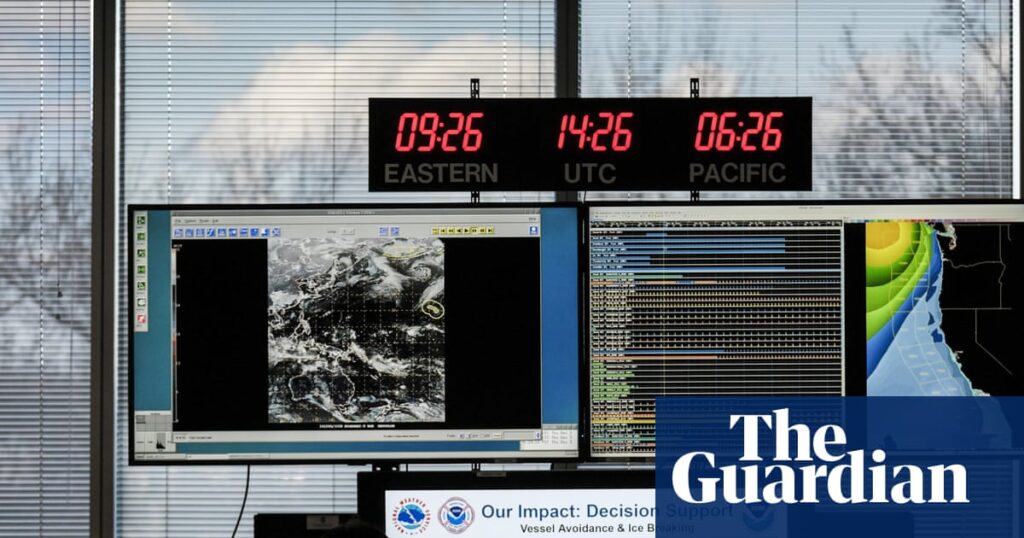

As the US prepares for hurricane season and a summer of record-breaking heat, experts fear the Trump administration’s cuts to climate and weather data programming could make the federal government’s weather forecasts less reliable when they are needed most.
The National Oceanic and Atmospheric Administration (Noaa) late last year launched a suite of artificial intelligence-powered global weather forecast models which it said would improve “speed, efficiency, and accuracy”. In March, an agency official said those models are being trained with centuries of weather data.
Artificial intelligence is a valuable tool for weather prediction, but only when it is well-trained with ample data, said Monica Medina, who served as Noaa’s principal deputy undersecretary of commerce for oceans and atmosphere from 2009 to 2012.
Under Trump, climate and weather data collection has declined, said Medina. This year, the Trump administration proposed a modest budget increase for the National Weather Service, but a 40% cut to Noaa overall.
“We absolutely need AI to help us crunch the data faster and to make sense of more and more data that we can collect,” said Medina, who under Joe Biden also served as assistant secretary of state for oceans. “But right now, what we’re doing is cutting back the data collection … we’re going in the wrong direction.”
In an emailed comment, Erica Grow Cei, a National Weather Service spokesperson said: “Despite the misinformation circulating about missing weather and climate data, there is, in fact, a wealth of weather data collected each day, from satellites in space, to a network of weather balloons, to buoys in the ocean, and land-based sensors.”
But widespread reports show staffing cuts have forced Noaa’s National Weather Service to scale back satellites and balloon launches, key parts of the country’s data collection system. And shrunk climate programs threaten ocean buoy networks and other observation systems, experts say. Research into effects of the climate crisis on Earth’s systems is also being slashed, along with funding for researchers who analyze data and identify new sources.
“Weather times time equals climate,” said Craig McLean, Noaa’s former acting chief scientist and head of Noaa Research. “Cutting climate research impacts the skill of our weather forecast, and it arrests our advancement of weather forecasts.”
Those impediments are coming as the US is preparing for more extreme weather. A “super El Niño” is expected to spike temperatures, smash heat records nationwide and may boost hurricane activity in some regions.
Noaa will issue its outlook for the 2026 Atlantic hurricane season on Thursday.
‘A climate that no longer exists’
For decades, scientists used traditional physics-based models to predict future weather conditions, using complex mathematical equations to simulate the dynamics at work…
Source link
Disclaimer
We strive to uphold the highest ethical standards in all of our reporting and coverage. We blogs.grocliq.com want to be transparent with our readers about any potential conflicts of interest that may arise in our work. It’s possible that some of the investors we feature may have connections to other businesses, including competitors or companies we write about. However, we want to assure our readers that this will not have any impact on the integrity or impartiality of our reporting. We are committed to delivering accurate, unbiased news and information to our audience, and we will continue to uphold our ethics and principles in all of our work. Thank you for your trust and support.
Website Upgradation is going on for any glitch kindly connect at [email protected]