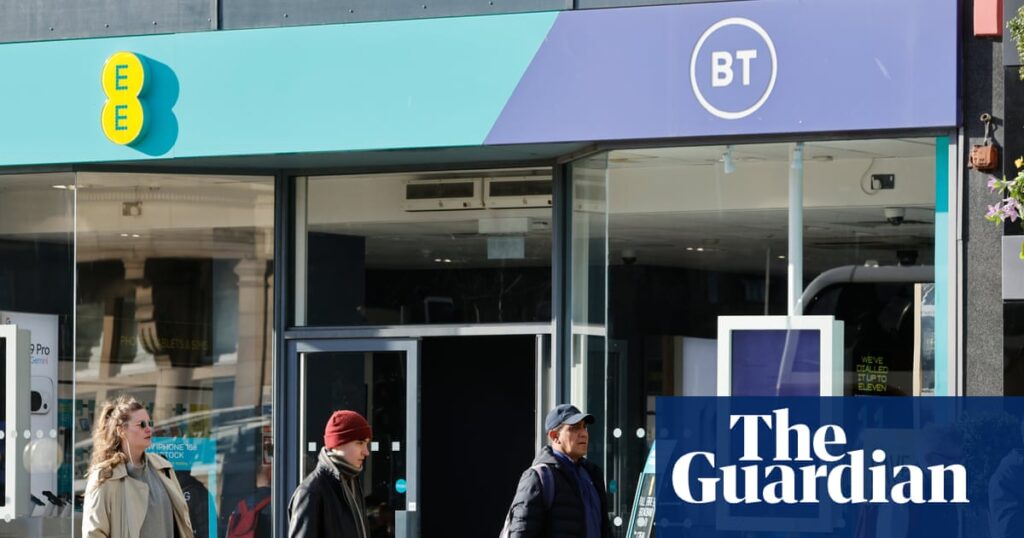

BT has said that the cost of smartphones could rise as technology companies buy up semiconductor chips due to the boom in artificial intelligence (AI), putting pressure on supply chains.
The telecoms company’s chief executive, Allison Kirkby, said she was anticipating shortages as tech firms bought large quantities of memory chips to power the datacentres relied on by AI.
Kirkby said: “It’s common knowledge that the chip market is under demand by the rise in AI. We are working very proactively with our suppliers.”
Price increases would mainly hit smartphone handsets, she said, but could also affect the cost of routers. Memory chips are essential for almost every modern item of electronics and are also used in other important components such as graphics cards.
Kirkby added: “I’m sure the industry with its partners will do the best it can to minimise the impact on pricing in the marketplace. But with chip shortages everywhere, that will put pressure on pricing in certain parts of the market, not just in our sector, going forward.”
She said she had not yet seen price increases from premium handset manufacturers, but expected companies such as Apple to pass higher costs on to customers. “I’m sure Apple will do the best to minimise any supply chain weaknesses,” she said.
The latest model of Apple’s smartphone, the iPhone 17, costs from £799, or £1,099 for the 17 Pro model, while Google’s Pixel 10 pro retails for about £1,199.
The largest manufacturers of laptops and phones, including Microsoft, Samsung and Dell, have already begun to put up prices in response to the chip shortages and have pulled cheaper models from the market.
Sony has also hiked the price of its PlayStation 5 consoles, including a $100 (£75) increase in the US, while Nintendo has confirmed a price rise for its Switch 2.
Updated US prices, which came into effect on 2 April, put the standard PS5 at $649.99, up from $549.99. The price of Nintendo’s Switch 2 will rise from September from $449.99 to $499.99 in the US, and €469.99 to €499.99 in most European countries.
A global investment spree in AI has led to a huge expansion of server farms, enormous banks of computers filled with high-end memory chips. These requirements are not only consuming the world’s current supply of chips, but also production capacity for the coming years, creating shortages and driving up the cost of electronics.
BT plans to cut costs by a further £700m over the next four years and reported flat full-year earnings and falling revenues.
The company increased its target for cost savings to £3.7bn, up from £3bn previously, and said it was extending its restructuring programme by a year to the end of March 2030.
BT lost 203,000 broadband customers in the first three months of this year, taking the total number of losses in the year to the end of March to 825,000, slightly lower than its forecast of 850,000. Kirkby added that the “churn” of mobile phone customers was at an all-time…
Source link
Disclaimer
We strive to uphold the highest ethical standards in all of our reporting and coverage. We blogs.grocliq.com want to be transparent with our readers about any potential conflicts of interest that may arise in our work. It’s possible that some of the investors we feature may have connections to other businesses, including competitors or companies we write about. However, we want to assure our readers that this will not have any impact on the integrity or impartiality of our reporting. We are committed to delivering accurate, unbiased news and information to our audience, and we will continue to uphold our ethics and principles in all of our work. Thank you for your trust and support.
Website Upgradation is going on for any glitch kindly connect at [email protected]