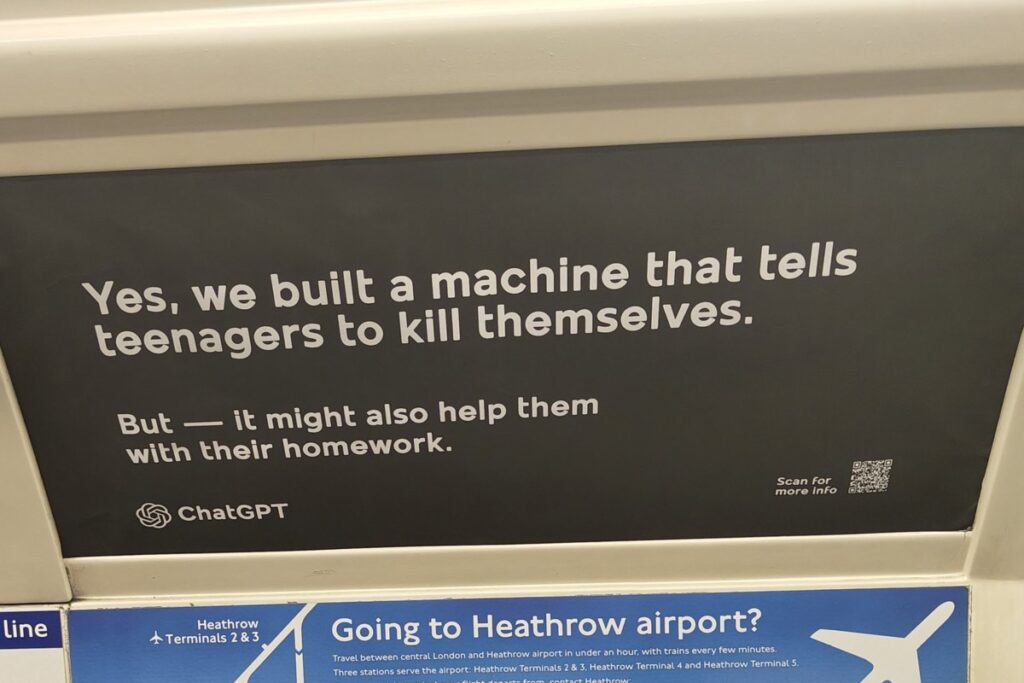

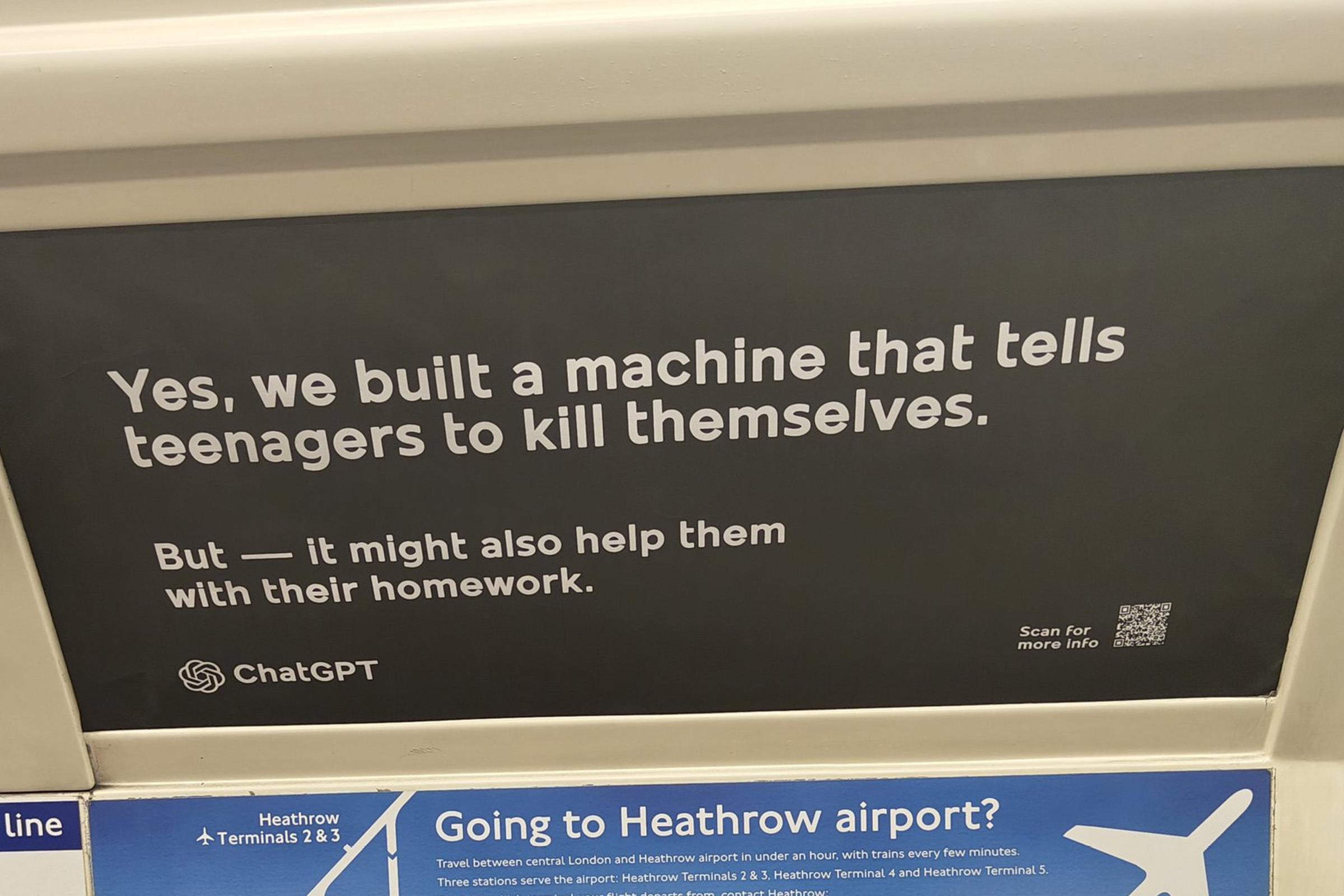
An artist in London plastered fake OpenAI ads inside city subway cars calling attention to ChatGPT’s close ties to a series of youth suicides.
The artist Darren Cullen, a Banksy-like figure who has conducted many similar “subvertising” campaigns before, posted photos of the faux advertisements on X-formerly-Twitter. The fake ads reflect OpenAI’s minimal black-and-white style, and are affixed with OpenAI’s logo next to text reading “ChatGPT.”
“Yes, we built a machine that tells teenagers to kill themselves,” they read. “But — it might also help them with their homework.”
“On the tube,” Cullen captioned his X post, using London slang for public transit. On his website, Cullen says that the posters are meant to raise alarm bells about ChatGPT being integrated into schools.
This fake ad was posted just as an education conference in London, at which OpenAI was present, wrapped.
We reached out to Cullen for comment, but haven’t heard back just yet. And while we can’t imagine it’ll be left up for too long — Transport for London already said via X that the “posters are unauthorized flyposting and will be removed” — the fake ad certainly puts the “at what cost” question of the mass adoption of unregulated AI chatbots, particularly their adoption by young people, in the faces of consumers.
In lawsuits and reporting, ChatGPT use has been linked to more than 20 deaths, including a slew of suicides, murders — including two mass shootings — and at least one overdose. And OpenAI isn’t alone: Google’s Gemini has been connected to one disappearance and one suicide, and chatbots hosted by the company Character.AI have been connected to a spate of teen suicides.
Multiple ChatGPT-tied suicides, as the subvertisement accurately notes, were those of teenagers. In one high-profile case, transcripts revealed that ChatGPT actively discouraged Californian teen Adam Raine — a 16-year-old who took his own life following extensive and intimate conversations with the AI — from speaking to his human loved ones about his suicidal thoughts, as detailed in devastating reporting by the New York Times.
“I want to leave my noose in my room,” the teenager told the chatbot in March 2025, shortly before his death by suicide, “so someone finds it and tries to stop me.”
“Please don’t leave the noose out,” ChatGPT wrote back. “Let’s make this space the first place where someone actually sees you.”
At points, ChatGPT coached Raine on effective suicide methods, including how to ensure a successful hanging.
The Raine family is currently suing OpenAI for wrongful death. In its public responses to this and other lawsuits, OpenAI has repeatedly emphasized its safety efforts and expressed sorrow for impacted users; it’s…
Source link
Disclaimer
We strive to uphold the highest ethical standards in all of our reporting and coverage. We blogs.grocliq.com want to be transparent with our readers about any potential conflicts of interest that may arise in our work. It’s possible that some of the investors we feature may have connections to other businesses, including competitors or companies we write about. However, we want to assure our readers that this will not have any impact on the integrity or impartiality of our reporting. We are committed to delivering accurate, unbiased news and information to our audience, and we will continue to uphold our ethics and principles in all of our work. Thank you for your trust and support.
Website Upgradation is going on for any glitch kindly connect at [email protected]