
Note: The discussion was held under the Chatham House Rule. All quotes have been edited for clarity and brevity.
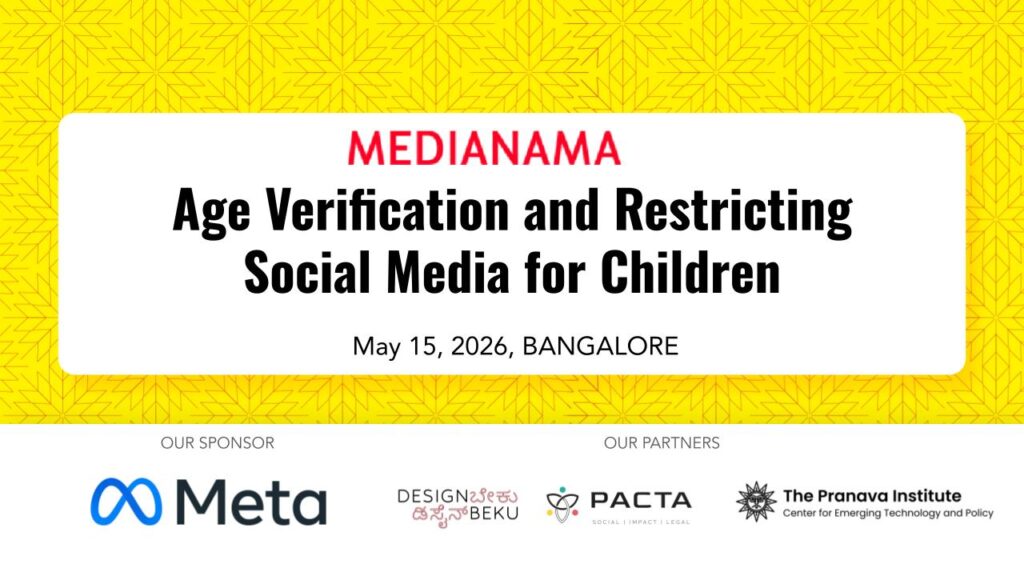
“We’re assuming here that verification is going to solve all our problems about children’s online safety. It’s a high effort, low impact, expensive, no-win proposition”, a speaker pointed out during MediaNama’s May 15 roundtable discussion in Bengaluru on ‘Age verification and restricting social media for children’, where speakers repeatedly raised concerns about how age verification at scale could lead to online surveillance of everyone, not just children.
Nikhil Pahwa, founder and editor-in-chief of MediaNama, argued that age verification systems cannot function without verifying everyone who uses a service. “To verify who’s a child, they’ll have to verify everyone who’s using a service,” he said. “Once that verification mechanism comes in, it will be used for everything.”
He added that social media would likely only be the beginning. “I’m sure gaming and AI will be the first to be included after social media is,” he said. “I see that as the first step in a longer direction of bringing age verification to everyone’s usage of the internet and age verification for almost everything on the internet.”
One participant said governments increasingly prefer verification-based systems as policy solutions. Pahwa similarly referred to what he described as a broader “regulatory proclivity towards verification.”
“All age verification in India becomes Aadhaar verification”: A major concern during the discussion was how age-assurance systems would likely operate in India. “No, no, they want to do Aadhaar verification,” Pahwa said during one exchange. “Let’s be very clear. All age verification in India becomes Aadhaar verification.”
Another participant referred to a newly launched Aadhaar-linked application that allows selective disclosure through QR codes. “You don’t need to share your address. You don’t need to share your father’s name. You can just share your age,” the speaker said while explaining the system.
Pahwa rejected the broader mechanism itself. “I don’t want to share my ID. I don’t want to share my age. I don’t want to do this mechanism,” he responded. Another participant argued that the debate was focusing on the wrong problem entirely. “Identification is irrelevant to the problem,” the speaker said. “If you’re reducing parental responsibility to declare age truthfully and then taking away the agency to be responsible to the child beyond that, then I’m just going to lie about her age.”
“The privacy risks are extremely high”: Several participants questioned whether large-scale age-assurance systems could exist without creating significant privacy risks. A speaker pointed out that governments and regulators had already realised “the error rates are high” and “the privacy risks and other types of risks…
Source link
Disclaimer
We strive to uphold the highest ethical standards in all of our reporting and coverage. We blogs.grocliq.com want to be transparent with our readers about any potential conflicts of interest that may arise in our work. It’s possible that some of the investors we feature may have connections to other businesses, including competitors or companies we write about. However, we want to assure our readers that this will not have any impact on the integrity or impartiality of our reporting. We are committed to delivering accurate, unbiased news and information to our audience, and we will continue to uphold our ethics and principles in all of our work. Thank you for your trust and support.
Website Upgradation is going on for any glitch kindly connect at [email protected]