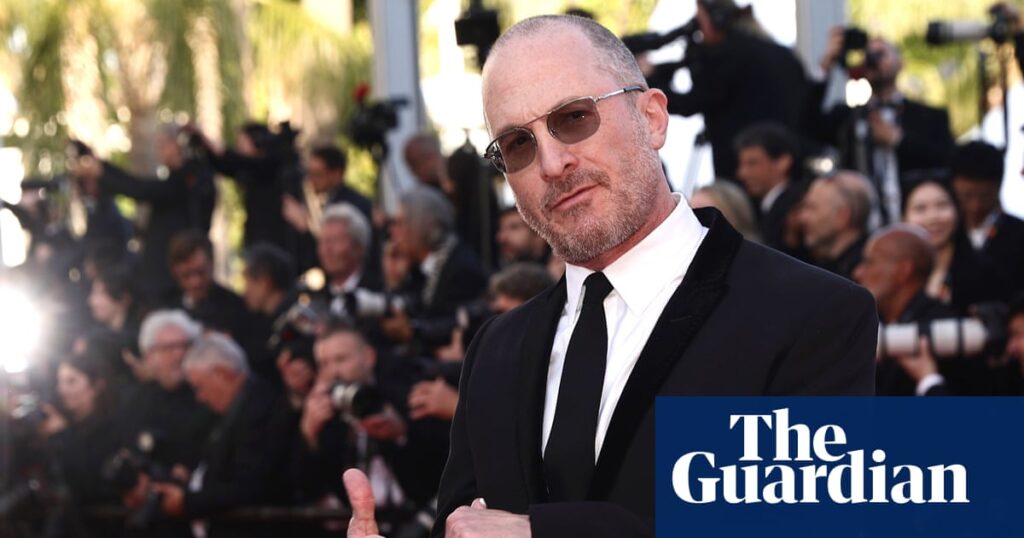

Under a white marquee on Cannes’ Croisette beach, with the Mediterranean glistening behind him and superyachts drifting across the horizon, the director Darren Aronofsky addressed an audience of executives and tech evangelists gathered for an “AI for Talent” summit.
“There’s so much pushback against AI,” said Aronofsky, who has faced criticism over his embrace of generative AI projects though his new studio, Primordial Soup, at a time when artificial intelligence has become one of the film industry’s most divisive fault lines.
“AI is a terrible word, because it’s a catchphrase for so many different things,” continued the director of Requiem for a Dream, The Wrestler, and Black Swan. “The thing we deal with when we’re talking to Chat GPT about the weather, or how to spend three days in Cannes, is very different to the AI we’re using to generate images. It’s not impersonating a person, it’s actually a tool.”
If Cannes is a barometer for the film industry’s anxieties and obsessions, this year the subject of AI dominated more than any other. From beachside summits and yacht parties to press conferences, leading figures debated whether AI was cinema’s next creative revolution or an existential threat to film-makers.
Aronofsky’s Primordial Soup has partnered with Google DeepMind on projects including Dustin Yellin’s short Goodnight Lamby, which premiered in Cannes.
He argued that the technology could solve practical and ethical production problems, citing one project in which AI tools allowed film-makers to avoid using a real newborn baby on set by digitally transforming what an actor was holding into “a live baby”. “None of these movies would exist without this technology,” he said. “They’re not replacing anything, they’re purely additive.”
Elsewhere in Cannes, AI startups and studios competed to position themselves at the forefront of Hollywood’s next transformation. During an event hosted on a yacht by the generative video platform Higgsfield, the film-maker Chuck Russell unveiled two AI-driven sci-fi features by his company Neumorphic AI. “AI technologies are expanding the cinematic toolbox to a scale we’ve never had before,” he said.
AI also became a talking point because of Oscar-winner Steven Soderbergh’s new documentary, John Lennon: The Last Interview. Created in partnership with Meta, the film reconstructs Lennon and Yoko Ono’s final radio conversation on 8 December 1980, using AI for about 10% of its imagery.
Soderbergh described the stylised sequences – including crying infants in 1960s clothing and cavemen acting out Lennon’s reflections on masculinity – as “thematic surrealism”, insisting they were intended as metaphor…
Source link
Disclaimer
We strive to uphold the highest ethical standards in all of our reporting and coverage. We blogs.grocliq.com want to be transparent with our readers about any potential conflicts of interest that may arise in our work. It’s possible that some of the investors we feature may have connections to other businesses, including competitors or companies we write about. However, we want to assure our readers that this will not have any impact on the integrity or impartiality of our reporting. We are committed to delivering accurate, unbiased news and information to our audience, and we will continue to uphold our ethics and principles in all of our work. Thank you for your trust and support.
Website Upgradation is going on for any glitch kindly connect at [email protected]