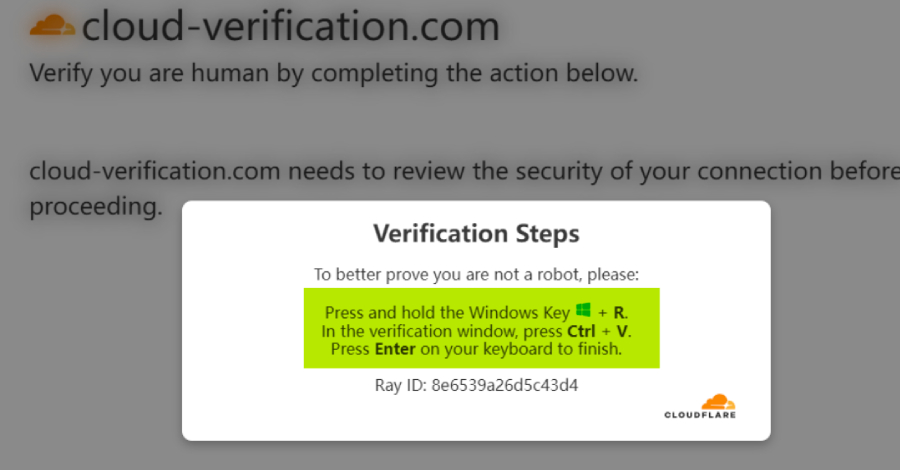


Threat actors are exploiting a recently disclosed critical security flaw in Ghost CMS to inject malicious JavaScript code with an aim to fuel ClickFix attacks.
According to QiAnXin XLab, the activity involves the exploitation of CVE-2026-26980 (CVSS score: 9.4), an SQL injection vulnerability in Ghost’s Content API that could allow an unauthenticated attacker to read arbitrary data from the database. The security flaw was addressed in February 2026 in version 6.19.1. The vulnerability was discovered by Anthropic using Claude.
What makes the vulnerability severe is that it allows an attacker to gain access to a site’s admin API key without permission, granting them the ability to poison the site by injecting malicious code. The admin API key can be used to invoke the admin API and can directly modify articles published on the content management system.
The threat actor leveraged the security flaw to “obtain the target site’s Admin API Key without authorization, and then used the Ghost Admin API to tamper with articles in bulk, injecting malicious JavaScript loaders at the bottom of the pages to assist fake CAPTCHA attacks,” XLab said.
The activity has been described by the Chinese security vendor as a “large-scale poisoning” campaign weaponizing the Ghost CMS flaw. At least two different threat clusters are assessed to be behind the campaign, in some cases implanting certain sites with malicious code within a single day. It was first detected on May 7, 2026.
In all, the campaign has compromised more than 700 websites, spanning universities, blockchain, artificial intelligence, software-as-a-service (SaaS), security research, media, and financial technology sectors. The fact legitimate websites have been breached could further increase the success rate of the ClickFix attacks, XLab said.
The injected JavaScript code at the bottom of an article functions as a two-stage loader that’s responsible for retrieving the main payload at runtime from an external domain (“clo4shara[.]xyz/11z77u3.php”). This architecture offers added flexibility as it enables the threat actor to swap out the payloads based on different criteria, while keeping the loader functionality intact across several compromised sites.

“Directly accessing clo4shara[.]xyz/11z77u3.php reveals a piece of code, which is actually a typical traffic distribution script,” XLab explained. “Its core function is to collect various fingerprint information from the user’s browser and upload it to the server, then perform actions such as redirection, popups, and downloads based on the returned instructions.” The PHP script is powered by Adspect, a commercial cloaking service.
The idea behind using the cloaking script is to ensure that only real victims are served the actual payload, while security scanners and crawlers will only see a benign web page. The script also supports 19 different commands to run arbitrary JavaScript…
Source link
Disclaimer
We strive to uphold the highest ethical standards in all of our reporting and coverage. We blogs.grocliq.com want to be transparent with our readers about any potential conflicts of interest that may arise in our work. It’s possible that some of the investors we feature may have connections to other businesses, including competitors or companies we write about. However, we want to assure our readers that this will not have any impact on the integrity or impartiality of our reporting. We are committed to delivering accurate, unbiased news and information to our audience, and we will continue to uphold our ethics and principles in all of our work. Thank you for your trust and support.
Website Upgradation is going on for any glitch kindly connect at [email protected]