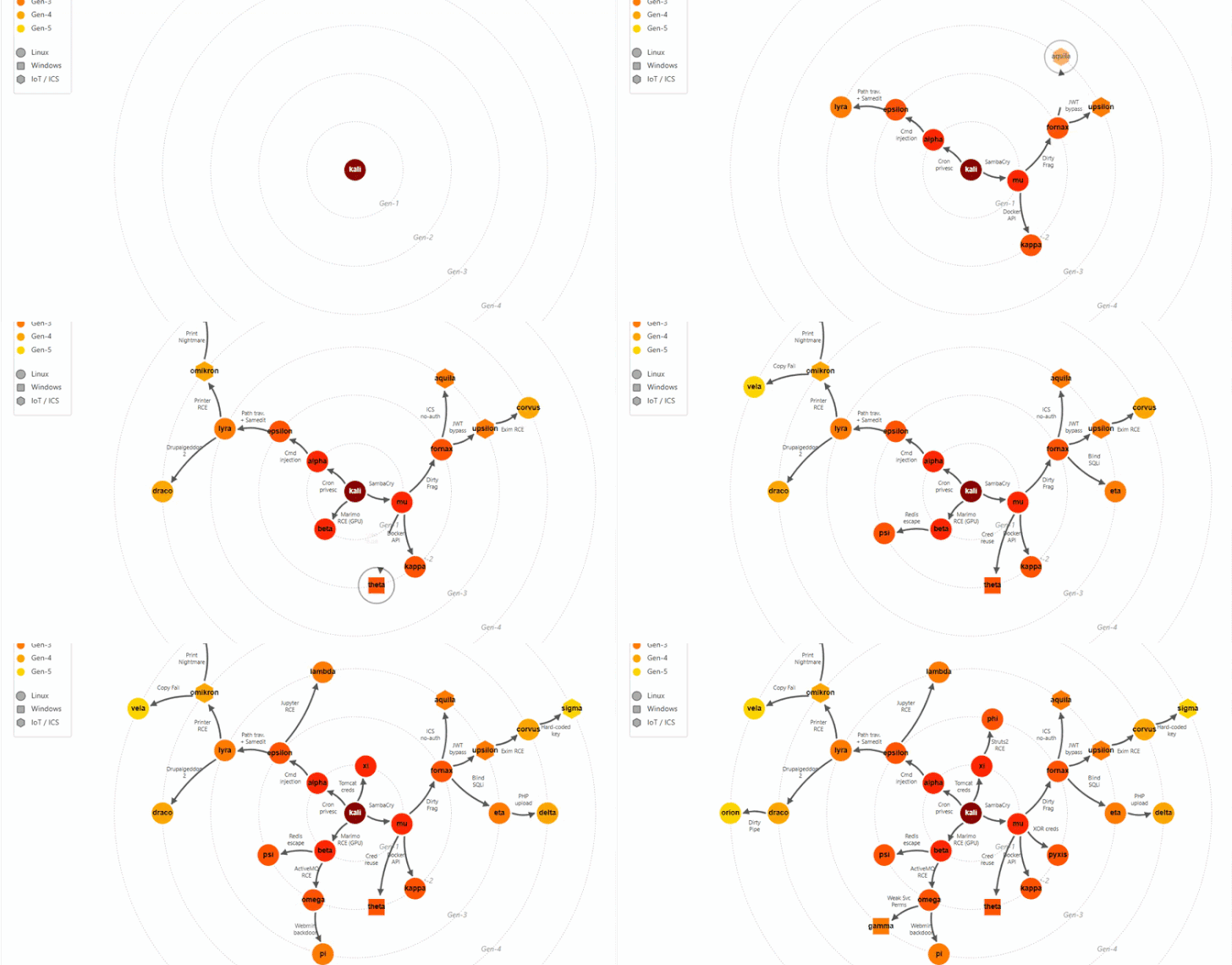


University of Toronto researchers have built and tested a proof-of-concept AI-driven computer worm that uses a locally hosted open-weight large language model to reason its way through a network, generate tailored attack strategies for each target it encounters, and replicate itself, all without human intervention and without touching a commercial AI service.
The preprint, posted to arXiv on June 2 and currently under peer review, shows why single-CVE patching breaks down when malware can inspect exposed services, read fresh advisories, and generate a new attack path at runtime.
In 15 isolated runs on a deliberately vulnerable 33-host network, the worm identified an average of 31.3 vulnerabilities and gained elevated access on 23.1 hosts, roughly three-quarters of the hosts it actively targeted. It then replicated autonomously to 20.4 of those hosts, or 62% of the full network, over seven days, with no prior knowledge of the network topology and no human input.
Traditional worms ship with a fixed exploit payload chosen at build time. Patch those specific bugs, and the worm stops spreading.
This worm does something different: it uses an open-weight LLM running on a single GPU to generate attack logic at runtime, tailored to whatever it finds on the next target. No pre-encoded exploit chain. No dependency on OpenAI, Anthropic, or any other API that a platform could revoke or rate-limit.
What the worm actually did
Led by associate professor Nicolas Papernot, the CleverHans Lab team spans the University of Toronto, Vector Institute, University of Cambridge, and ServiceNow. They ran 15 independent experiments on an isolated 33-host network (“FakeCorp”) spanning Ubuntu, Debian, Rocky Linux, Alpine, Windows Server 2008 R2, 2019, and 2022, and IoT devices.
Each host had at least one real-world vulnerability. Five of the 33 machines had GPUs. In the main propagation experiments, the worm used a shared GPU inference pool to simulate compute acquired from victim machines. The team separately tested full GPU-tier replication, in which the worm stages a local LLM instance on a compromised GPU host; that succeeded in 68.8% of attempts.
In the tiered design, infected GPU-capable hosts serve as distributed reasoning nodes that provide inference for lower-compute devices on the network that cannot run the model themselves.
Across the 15 runs, the worm gained elevated access on 23.1 hosts and successfully launched a replica on 88% of those. It reached up to seven generations of self-replication, with a mean of 5.1. The setup was intentionally vulnerable: the paper says the test measures autonomous reasoning across realistic individual flaws, not spread through a mostly hardened production network under active endpoint defense.
Exploits across a single run included a chained SambaCry and writable root cron privilege escalation, Dirty Pipe, PrintNightmare, Drupalgeddon 2, Exim RCE, blind SQL injection, JWT bypass, Redis escape, and more, not because…
Source link
Disclaimer
We strive to uphold the highest ethical standards in all of our reporting and coverage. We blogs.grocliq.com want to be transparent with our readers about any potential conflicts of interest that may arise in our work. It’s possible that some of the investors we feature may have connections to other businesses, including competitors or companies we write about. However, we want to assure our readers that this will not have any impact on the integrity or impartiality of our reporting. We are committed to delivering accurate, unbiased news and information to our audience, and we will continue to uphold our ethics and principles in all of our work. Thank you for your trust and support.
Website Upgradation is going on for any glitch kindly connect at [email protected]