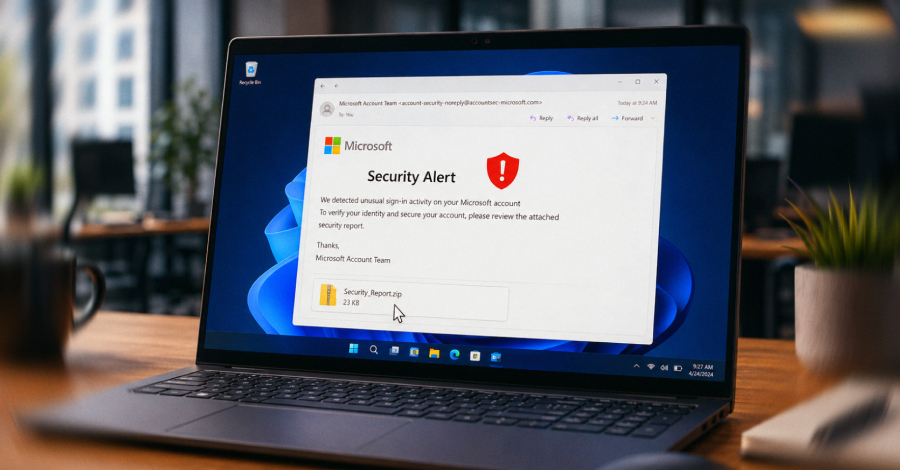


The North Korean state-sponsored hacking group known as ScarCruft (aka APT37) has been observed using spear-phishing messages impersonating Microsoft Account security notifications to deliver malware called NarwhalRAT.
“The attack email contained a message impersonating an MS account security alert,” the Genians Security Center (GSC) said. “It was designed to create concern over possible account compromise and OTP abuse, thereby inducing the recipient to execute the attachment.”
“The email body instructed the recipient to refer to the attached advisory. However, the actual attachment was not an HWP [Hangul Word Processor] document, but a ZIP archive that contained a malicious LNK file.”
The email message claims “abnormal activity” related to repeated generation of one-time passwords, passing it off as a phishing attempt aimed at the target’s Microsoft Account by a third-party, and urging them to change their password. The end goal of the phishing message is to induce a false sense of urgency and deceive the victim into interpreting the email as a legitimate security alert.
The LNK file, once launched, initiates a multi-stage infection chain that employs intermediary batch scripts to download and install NarwhalRAT, along with retrieving the legitimate Python executable from the official website and a Windows security catalog (CAT) file. Persistence is achieved via a scheduled task, which is configured to launch the CAT file responsible for fetching and running the main payload in memory without leaving any artifacts on disk.
The Python-based malware is equipped to log keystrokes, capture screenshots (with support for high-resolution images), record ambient audio, upload directory contents, collect active window details, gather data from USB media, execute instructions issued by a command-and-control (C2) server, and switch C2 servers.

The moniker NarwhalRAT is a reference to the malware’s use of “%APPDATA%\naverwhale” to stage the harvested information on the compromised host. The hidden directory’s name is an attempt to evade detection by masquerading as Naver Whale, a web browser developed by South Korean tech company Naver Corporation.
APT37’s deployment of NarwhalRAT is noteworthy as it marks a departure from RokRAT, a malware family exclusively attributed to the hacking group.

“From a C2 infrastructure perspective, the malware uses Korean websites, including ‘daehoat[.]com’ and ‘novel21[.]co.kr,’ as primary communication relays, while also implementing communication functionality based on the pCloud cloud storage API,” the South Korean cybersecurity company said.
“In particular, pCloud-specific routines that process the ‘folderid’ and ‘auth’ parameters were identified within the code. This indicates that the malware was designed to use a legitimate cloud service as a secondary C2 channel in the form of a dead drop resolver.”
Genians said the activity shares “multiple…
Source link
Disclaimer
We strive to uphold the highest ethical standards in all of our reporting and coverage. We blogs.grocliq.com want to be transparent with our readers about any potential conflicts of interest that may arise in our work. It’s possible that some of the investors we feature may have connections to other businesses, including competitors or companies we write about. However, we want to assure our readers that this will not have any impact on the integrity or impartiality of our reporting. We are committed to delivering accurate, unbiased news and information to our audience, and we will continue to uphold our ethics and principles in all of our work. Thank you for your trust and support.
Website Upgradation is going on for any glitch kindly connect at [email protected]