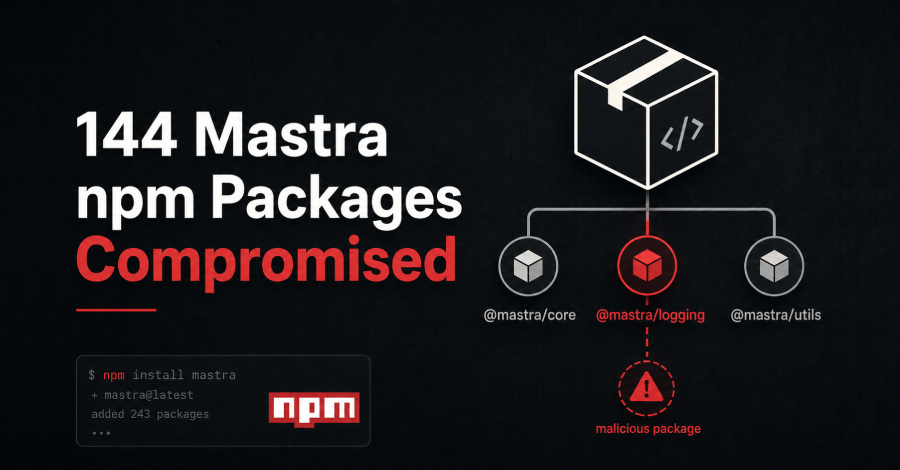


As many as 144 npm packages associated with the Mastra namespace (“@mastra/*”), a popular open-source JavaScript and TypeScript framework for building artificial intelligence (AI) applications, have been compromised as part of a software supply chain attack codenamed easy-day-js, per findings from JFrog, SafeDep, Socket, and StepSecurity.
“A single npm account (ehindero) mass-published more than 140 malicious packages across the Mastra scope within a short window on 2026-06-17,” Socket said.
The infected packages themselves do not include malicious code. Instead, it’s introduced by means of a third-party library named “easy-day-js” that has been added to each package’s dependency list. The JavaScript library was published by an npm user called “sergey2016” on June 16, 2026, at 7:05 a.m. UTC as a clean, fully functional copy, with the malicious changes introduced on June 17, 2026, at 1:01 a.m. UTC.
The “easy-day-js” package launches an obfuscated payload that’s fired during a postinstall hook, which acts as a dropper or loader for a second-stage payload retrieved from attacker-controlled infrastructure (“23.254.164[.]92”) after disabling TLS certificate validation.
The payload is then executed as a detached background process, following which the loader takes steps to erase itself to minimize the forensic trail.
The final stage is a cross-platform information stealer that can harvest browser history, store data from over 160 cryptocurrency wallet browser extensions, install persistence across Windows, macOS, and Linux, and exfiltrate the captured information to the C2 server (“23.254.164[.]123”).
In its analysis, SafeDep described “easy-day-js” as a clone of the “dayjs” date library that downloads and runs a cryptocurrency-stealing remote access trojan. The attackers behind the campaign are said to have hijacked the “ehindero” account, a legitimate former Mastra contributor whose scope access was never revoked. Npm has since pulled the malicious versions from the highest-profile packages and reverted their latest tag.
 |
| Image Source: StepSecurity |
“Mastra ships its real releases from CI through npm’s trusted publisher flow, and each one carries SLSA provenance attestations,” SafeDep said. “The attacker pushed the malicious versions from a personal token and dropped the provenance.”
“The same fingerprint repeats across the whole scope. Mastra generated provenance on CI publishes but did not require it, so a standard npm token could still publish without attestations. A signature-verifying install (npm audit signatures, or a policy that requires attestations) would have rejected every package in this wave.”
Any workstation, CI runner, or build environment that installed the affected versions should be treated as potentially compromised. It’s advised to roll back to a safe version, rotate any credentials, and audit the hosts for any artifacts linked to the campaign.
“The affected…
Source link
Disclaimer
We strive to uphold the highest ethical standards in all of our reporting and coverage. We blogs.grocliq.com want to be transparent with our readers about any potential conflicts of interest that may arise in our work. It’s possible that some of the investors we feature may have connections to other businesses, including competitors or companies we write about. However, we want to assure our readers that this will not have any impact on the integrity or impartiality of our reporting. We are committed to delivering accurate, unbiased news and information to our audience, and we will continue to uphold our ethics and principles in all of our work. Thank you for your trust and support.
Website Upgradation is going on for any glitch kindly connect at [email protected]