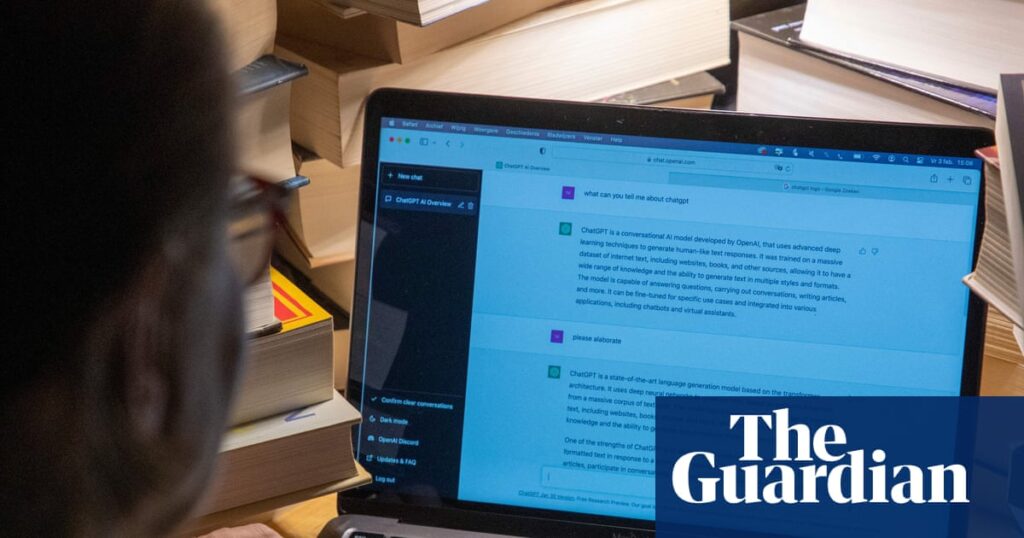

A new study from the Massachusetts Institute of Technology is the latest research to find that relying too much on chatbots can diminish critical-thinking skills, and potentially decrease our ability to discern misinformation for ourselves.
As AI tools are becoming more sophisticated and accessible, manipulated images and misleading headlines are becoming more common. AI can be part of the solution, and has proved useful in helping users identify fake content – but there’s a cost to using it this way, the new research suggests. An over-dependence on AI to help figure out what’s real on the internet can lead to trouble making those judgments.
During the four-week study, released in April, researchers tracked 67 participants and quizzed them on whether pairs of news-related headlines and images were real. They found that AI assistants like Claude and ChatGPT would be useful for detecting fake news – but when participants relied on them too much, they became worse at spotting misinformation.
Researchers also found that when it came to deciding which news headlines and images were real, AI often prioritized an accurate response, rather than cultivating an ability to think. This dependency could actually worsen judgment in the long-term, according to the study.
“When we’re interacting with AI, we feel we’re becoming better at certain tasks and there’s enough research that shows we are not,” says Anku Rani, a PhD student at MIT and co-lead author of the study.
Participants in the month-long study were asked to respond to questions about fake news and images with and without the help of an AI assistant that runs on GPT-4o and is integrated with Google search. The chatbot could hint at clues to look for; one example showed the AI chatbot advising a user to take a closer look at a police badge that revealed an image was fake.
The study authors evaluated how helpful AI was in guiding participants to make an accurate decision, as well as how their independent judgment changed over time. They found a trade-off: AI helped participants better discern what’s real – and resulted in a 21% higher chance they would make the right call. But their unassisted performance, when reviewing new images without AI’s help, grew 15.3% worse in the experiment’s fourth week. “These results indicate that while AI may help immediately, it may ultimately degrade long-term misinformation detection abilities,” the study noted.
Concerns about the effects of depending too much on AI, and even other forms of technology, aren’t new. Calculators and GPS devices have dulled the ability to do mental math and navigate neighborhoods without assistance. A 2025 Lancet study found that doctors who use AI classification tools to detect cancer eventually became worse at doing so on their own. A neuroscientist at the Possibility Institute, a metascience research group, recently warned that diverting too much of one’s thinking to AI can weaken the brain’s defenses…
Source link
Disclaimer
We strive to uphold the highest ethical standards in all of our reporting and coverage. We blogs.grocliq.com want to be transparent with our readers about any potential conflicts of interest that may arise in our work. It’s possible that some of the investors we feature may have connections to other businesses, including competitors or companies we write about. However, we want to assure our readers that this will not have any impact on the integrity or impartiality of our reporting. We are committed to delivering accurate, unbiased news and information to our audience, and we will continue to uphold our ethics and principles in all of our work. Thank you for your trust and support.
Website Upgradation is going on for any glitch kindly connect at [email protected]