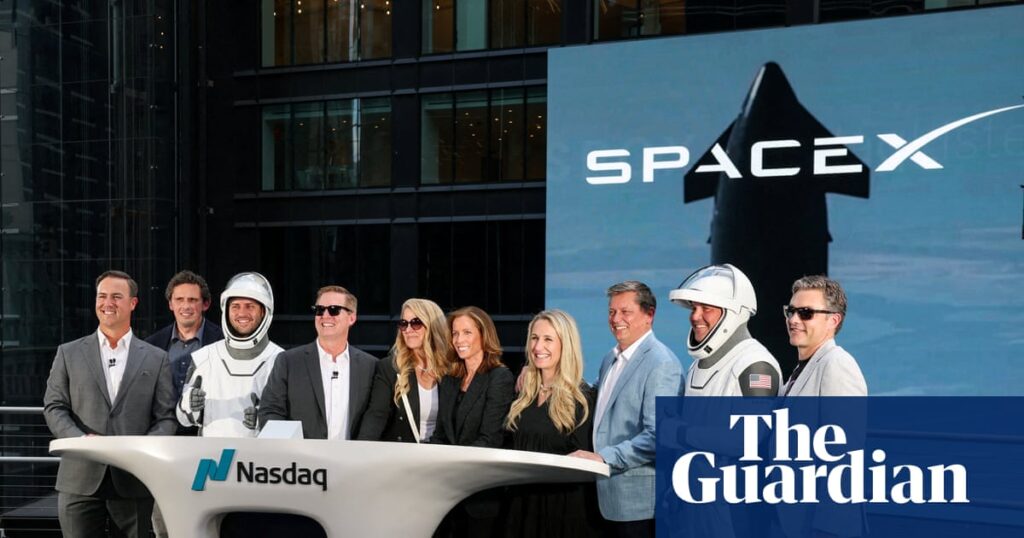

Elon Musk became the world’s first trillionaire last week after SpaceX debuted on the stock market with a valuation of $1.77tn.
Millions of Americans could soon become indirect investors in SpaceX and other emerging AI-focused companies as US markets increasingly shift toward AI-driven investments.
Many Americans’ retirement savings are heavily tied to the US stock market through private 401(k) retirement savings plans. Those plans are heavily invested in index funds that track the major stock market indices. So even those who do not invest directly in these new tech giants may still end up owning them.
Musk pushed for a rule change to allow SpaceX shares into index funds earlier than is typical, many Americans could find their retirement savings and pensions increasingly tied to the company and other AI firms.
“We’ve all been forced into a giant casino,” said Tim, a 62-year-old engineer based in Alameda, California.
The Guardian asked people in the US their views on the SpaceX initial public offering (IPO) and how it might affect them. More than 150 responded, overwhelmingly to express concern about having their savings tied to major technology firms, citing fears over widening inequality, market instability, and the long-term sustainability of the AI boom.
For Tim, a 62-year-old engineer based in Alameda, California, investing in SpaceX is less a choice than a necessity.
“I’ve never wanted to participate in the so-called AI bubble,” Tim continued. “Basically my entire retirement is in the S&P 500. Not out of choice, but if you don’t have investments in the stock market, you’re losing ground compared to everybody who does. That’s the pernicious thing about it. There’s really no way for the average person to diversify.”
Stephen, a 33-year-old engineer from Michigan, shares his unease and describes his disgust over the growing influence of tech companies over retirement savings.
“I think that the amount is absolutely ridiculous and untethered to the company’s actual value,” he said. “I think it’s abhorrent that my savings and retirement funds are tied so intricately to these tech companies, especially when they cannot be held accountable by investors.”
Similar concerns were raised by Matt Reynolds, a 57-year-old professor based in eastern Washington, who worries both about his financial future and the influence of tech moguls.
“As someone looking to retire in the next five to 10 years, I’m alarmed at big tech’s market consolidation and its impact on my savings and investments. As a human being, I’m distraught that these companies all seem to be run by people with little accountability or moral compass,” he said. “How and why do my finances have to be bound to a racist, narcissistic, baby man who does not seem to care about other human beings? Everything about this is wrong.”
For Kendra Ford, a 54-year-old mother and climate activist based in Portsmouth, New Hampshire, the issue is both financial and…
Source link
Disclaimer
We strive to uphold the highest ethical standards in all of our reporting and coverage. We blogs.grocliq.com want to be transparent with our readers about any potential conflicts of interest that may arise in our work. It’s possible that some of the investors we feature may have connections to other businesses, including competitors or companies we write about. However, we want to assure our readers that this will not have any impact on the integrity or impartiality of our reporting. We are committed to delivering accurate, unbiased news and information to our audience, and we will continue to uphold our ethics and principles in all of our work. Thank you for your trust and support.
Website Upgradation is going on for any glitch kindly connect at [email protected]