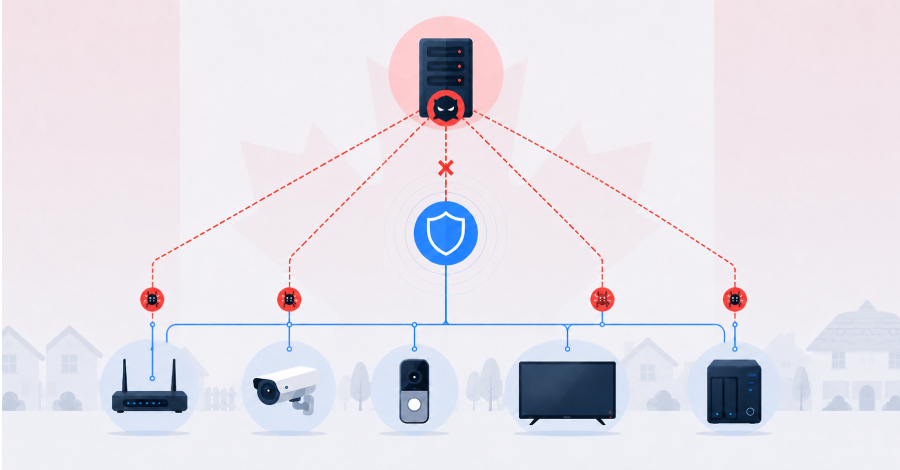


Canada’s spy service got a judge’s permission to reach into infected servers, home routers, and IoT gear sitting on Canadian soil and neutralize two foreign-run botnets.
The Federal Court released a public version of the ruling on June 15. It is the first time the Canadian Security Intelligence Service has used its threat reduction warrant powers this way.
The warrant let CSIS alter, degrade, and destroy botnet data on the infected machines and cut the devices loose from the networks.
The targets were Canada-based servers, small office and home office (SOHO) routers, and Internet of Things devices: Ring doorbells, security cameras, TVs, and other Wi-Fi-enabled appliances.
Justice Catherine Kane granted the warrant on May 1, 2024, renewed it that August, and issued the confidential reasons in February 2026. The warrant stayed out of public view for more than two years, until this month’s redacted release.
CSIS needed the order because the cleanup would likely have been a crime without it. Reaching into someone else’s device and wiping data is computer mischief under the Criminal Code, so the Service needed a judge’s sign-off before touching the machines.
The court found the threat to Canada clearly established and imminent, and the measures necessary, reasonable, and proportional. It stressed the operation went after devices, not people: no user identities sought, no content intercepted, any personal data swept up incidentally destroyed.
The two botnets ran the standard relay playbook. A command tier issued the orders; a layer of infected devices relayed the traffic. By routing through hijacked Canadian hardware, a foreign state can look like an ordinary connection, a home worker, or an ISP customer, while it probes critical infrastructure, government, and military networks.
The owner of the infected doorbell gets left looking responsible for traffic they never sent. The court flagged the energy sector among the targets and warned that the adversaries could direct the botnets to probe and potentially disrupt Canadian infrastructure.
The public ruling settles the what: two foreign adversaries, a threat to Canada’s security, the court found clearly made out. What it strips is the who. The timing and the technique match a specific moment in early 2024, but The Bureau, which surfaced the ruling, says it cannot tell from the redacted reasons whether Canada’s two botnets were both Chinese, both Russian, or one of each. The foreign-state hand is a finding. The flag is the redaction.
Same Tactic, a Different Authority
That moment was a run of court-ordered botnet cleanups in the United States. In a December 2023 operation, the FBI used the botnet’s own command channel to delete the KV-botnet malware from hundreds of U.S. SOHO routers, mostly end-of-life Cisco and NetGear boxes that the China-linked Volt Typhoon was using to hide access it had planted ahead of a possible crisis inside American communications, energy, water, and…
Source link
Disclaimer
We strive to uphold the highest ethical standards in all of our reporting and coverage. We blogs.grocliq.com want to be transparent with our readers about any potential conflicts of interest that may arise in our work. It’s possible that some of the investors we feature may have connections to other businesses, including competitors or companies we write about. However, we want to assure our readers that this will not have any impact on the integrity or impartiality of our reporting. We are committed to delivering accurate, unbiased news and information to our audience, and we will continue to uphold our ethics and principles in all of our work. Thank you for your trust and support.
Website Upgradation is going on for any glitch kindly connect at [email protected]