
The artificial intelligence industry is spending heavily in the 2026 midterms, hoping to secure influence over the technology’s first generation of legislation – and New York City’s primary has emerged as the key battleground.
AI-focused Super Pacs have raised roughly $100m this cycle, of which $44m has been spent so far, in dozens of congressional races across the country. Nearly half of all spending has converged on a single Manhattan race: Tuesday’s Democratic primary in the district of NY-12.
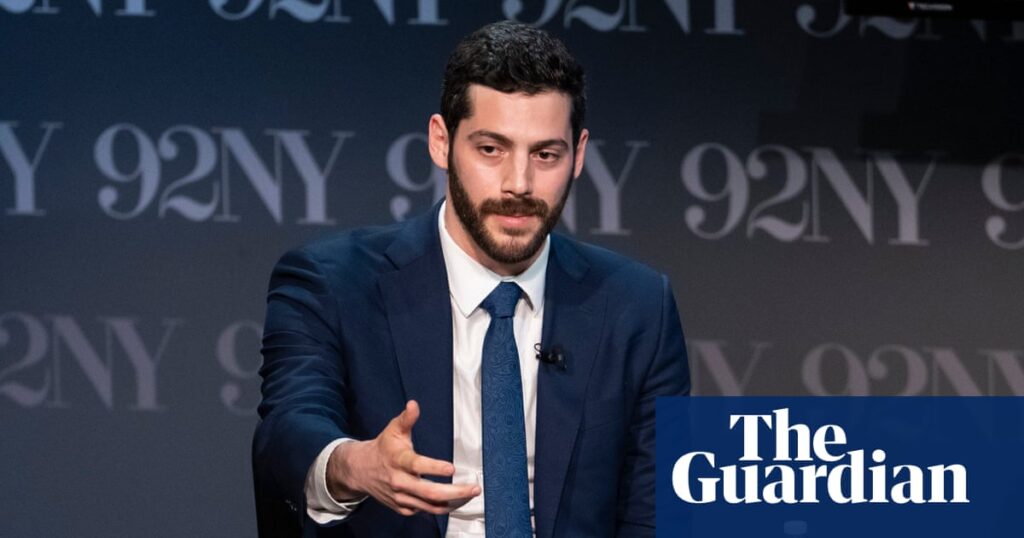
And much of that spending has targeted a single candidate: Democratic assemblymember Alex Bores, who is running to represent New York’s 12th House district. Bores, who worked in tech before his pivot to politics, has found himself at the unlikely center of a proxy battle for the industry’s tussle for regulatory influence.
The frenzy began a year ago, when Bores sponsored the Raise Act, the second-ever US state law requiring major AI developers to publish public safety plans. By August, his congressional campaign was under siege – attack ads on TV, by text, in the mail. The effort has been funded by Think Big, an affiliate of Leading the Future, a new bipartisan network of Super Pacs created to back “pro-AI” candidates, which has poured $8.2m into the primary.
Just four donors fund its $75m war chest: venture capitalists Marc Andreessen and Ben Horowitz, and OpenAI co-founder Greg Brockman with his wife, Anna, according to data from the Federal Election Commission (FEC). Like most of Silicon Valley, the group advocates for regulating AI with a federal framework, instead of a patchwork of state laws – a compliance minefield that will hand the AI race to China, tech firms warn.
However, Leading the Future’s anti-Bores ad blitz triggered a counter-assault by a different set of Super Pacs advocating for stronger AI safeguards. They include You Can Push Back, funded by crypto billionaire Chris Larsen, and Jobs and Democracy, the Democrat-focused subsidiary of the Public First – a network of Super Pacs, founded by Brad Carson, a former Democratic congressman from Oklahoma.
The message Leading the Future was sending, in Carson’s read: regulate AI, and we will find you, wherever you are. A former Andreessen Horowitz general partner made much the same case in a New York Times op-ed last week, accusing the industry of trying to intimidate anyone who engages “too aggressively” with AI governance. Leading the Future did not respond to a request for comment.
Public First’s funding is murky, however. The dark-money group bankrolling Public First isn’t required to disclose its donors, but the artificial intelligence company Anthropic has publicly announced a $20m contribution. Since its founding, Anthropic has marketed itself as the conscience of the AI industry: a company racing to build powerful models while warning publicly about the risks they could pose, and even floating the idea of a “temporary pause” on AI development.
According…
Source link
Disclaimer
We strive to uphold the highest ethical standards in all of our reporting and coverage. We blogs.grocliq.com want to be transparent with our readers about any potential conflicts of interest that may arise in our work. It’s possible that some of the investors we feature may have connections to other businesses, including competitors or companies we write about. However, we want to assure our readers that this will not have any impact on the integrity or impartiality of our reporting. We are committed to delivering accurate, unbiased news and information to our audience, and we will continue to uphold our ethics and principles in all of our work. Thank you for your trust and support.
Website Upgradation is going on for any glitch kindly connect at [email protected]