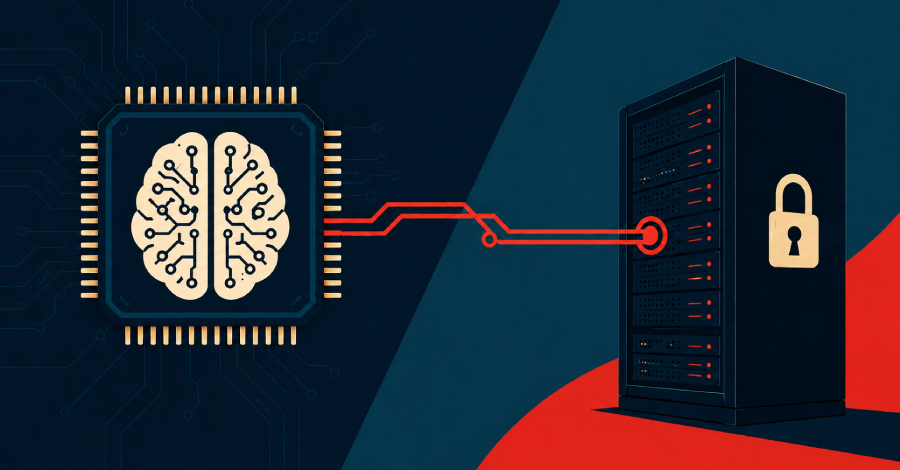


Every weapon begins as an extension of the hand that holds it. The spear lengthened the reach of the arm. The bow sent the point flying without the throw. The rifle placed a man’s death a quarter mile beyond his sight, and the aircraft carried that death across oceans. At each turn, the distance between the warrior and the wound grew wider, and yet one thing never moved: a human chose the target, and a human struck the blow. For the entire history of conflict, the cyber realm included, the hand has remained on the weapon.
Offensive AI is the moment the weapon learns to aim itself.
For three years, artificial intelligence (AI) has been an extension of the pen. It drafted the phishing email, proposed the exploit, sketched the malicious function, and then, like every tool that came before it, handed the work back to a human to carry out. In 2023, I published a whitepaper at the SANS Technology Institute showing how a person of almost no skill could coax a chatbot into producing malware that strolled past the controls built to stop it. That was the age of the assistant: dangerous, certainly, but still leashed to the operator who held it. Agentic AI severs the leash. It takes the objective and walks the steps itself. This single change, from a tool that drafts to a tool that acts, is reshaping offensive operations faster than the defenses built to catch them, and it cuts in two directions at once. It grants real capability to attackers who never possessed any, and it lends ferocious speed to those who were already deadly.
If your trade is offensive work, this is the ground you now stand upon. The tooling an adversary turns against a target is the tooling you must be capable of turning yourself, and it has marched far beyond chatbots composing prettier phishing. It is worth studying, with clear and unsentimental eyes, what these agents can do today, how they let you operate at a pace that lately seemed impossible, and where they will quietly walk you off a cliff should you follow them with too much faith.
The Gate Has Fallen
Consider the entry-level threat actor, historically limited by a lack of technical expertise. Such individuals can now leverage agents to develop exploits and conduct campaigns autonomously. Technical mastery is no longer a prerequisite; intent and access to capable tools suffice. I refer to this phenomenon as ‘script kiddie as a service,’ signifying the emergence of sophisticated attacks from previously unskilled actors.
A further implication is that the limitations of unskilled attackers are now defined by the capabilities of their chosen AI models rather than their own expertise. As numerous untrained actors employ similar models in comparable ways, their attack methodologies begin to converge, resulting in a behavioral monoculture. While this increases the volume of competent attacks, it also creates recognizable patterns, such as standardized phishing and exploit chains. Skilled adversaries will adapt beyond these…
Source link
Disclaimer
We strive to uphold the highest ethical standards in all of our reporting and coverage. We blogs.grocliq.com want to be transparent with our readers about any potential conflicts of interest that may arise in our work. It’s possible that some of the investors we feature may have connections to other businesses, including competitors or companies we write about. However, we want to assure our readers that this will not have any impact on the integrity or impartiality of our reporting. We are committed to delivering accurate, unbiased news and information to our audience, and we will continue to uphold our ethics and principles in all of our work. Thank you for your trust and support.
Website Upgradation is going on for any glitch kindly connect at [email protected]