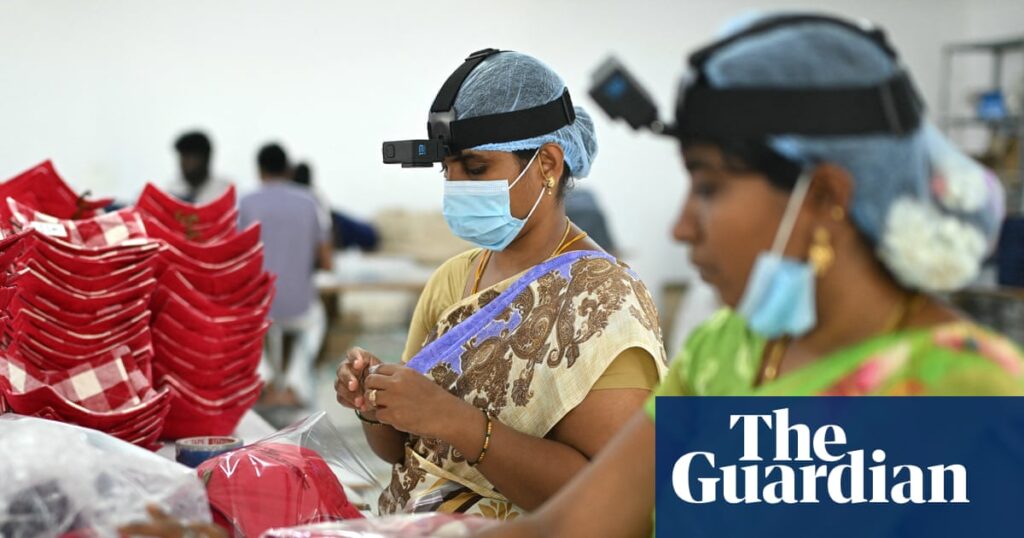

The first time the factory supervisors handed garment worker Lalita* a head-mounted camera, she burst out laughing. “The way people mount a CCTV camera on a wall, they mounted one on us,” she says.
The 32-year-old had been working at the garment factory on the outskirts of Delhi for nearly a year when management asked workers on her line to strap small cameras to their foreheads before starting their shifts. Nobody explained why.
As Lalita sat stitching shirts and trousers, the camera recorded everything: the rhythm of her hands guiding cloth through the sewing machine; the precision with which she aligned collars and seams; the speed at which her fingers corrected folds and imperfections; even interactions with colleagues. “We found it funny at first, because of how we all looked with that headgear,” she says.
But the atmosphere on the factory floor soon started to change. Worried that their productivity was being monitored, workers became more conscious of their movements. Conversations that would ordinarily unfold across sewing lines grew quieter. Some paid greater attention to their work, wary that every mistake, pause or distraction could be captured on camera.
What Lalita and her colleagues did not know was that their daily routines were being captured as part of a growing effort by companies in India to collect first-hand data from factory floors, information increasingly valuable in the race to automate industrial work.
First-person recordings of human movements and interactions are called egocentric data and are vital for training robots that might one day replace humans on the production line.
Humanoid robots have emerged as the latest frontier in the rapid evolution of artificial intelligence. Industry experts increasingly describe data as the biggest bottleneck in robotics and automation. Unlike large language models such as ChatGPT or Gemini, which were trained on vast quantities of text available online, robots require first-person recordings of physical work.
Companies collecting egocentric footage say the future may require hundreds of millions – and potentially billions – of hours of human activity filmed across factories, warehouses, shops and homes before robots can reliably navigate real-world environments.
EgoLab, an Indian data aggregation company extracting this information from Lalita’s factory in Gurugram, a city in the state of Haryana, counts Tesla among its biggest clients. The company’s CEO, Elon Musk, has predicted that roughly 80% of Tesla’s future value will come not from electric vehicles, but from its humanoid robots.
India is fast becoming a crucial hub in the global race to collect egocentric data….
Source link
Disclaimer
We strive to uphold the highest ethical standards in all of our reporting and coverage. We blogs.grocliq.com want to be transparent with our readers about any potential conflicts of interest that may arise in our work. It’s possible that some of the investors we feature may have connections to other businesses, including competitors or companies we write about. However, we want to assure our readers that this will not have any impact on the integrity or impartiality of our reporting. We are committed to delivering accurate, unbiased news and information to our audience, and we will continue to uphold our ethics and principles in all of our work. Thank you for your trust and support.
Website Upgradation is going on for any glitch kindly connect at [email protected]