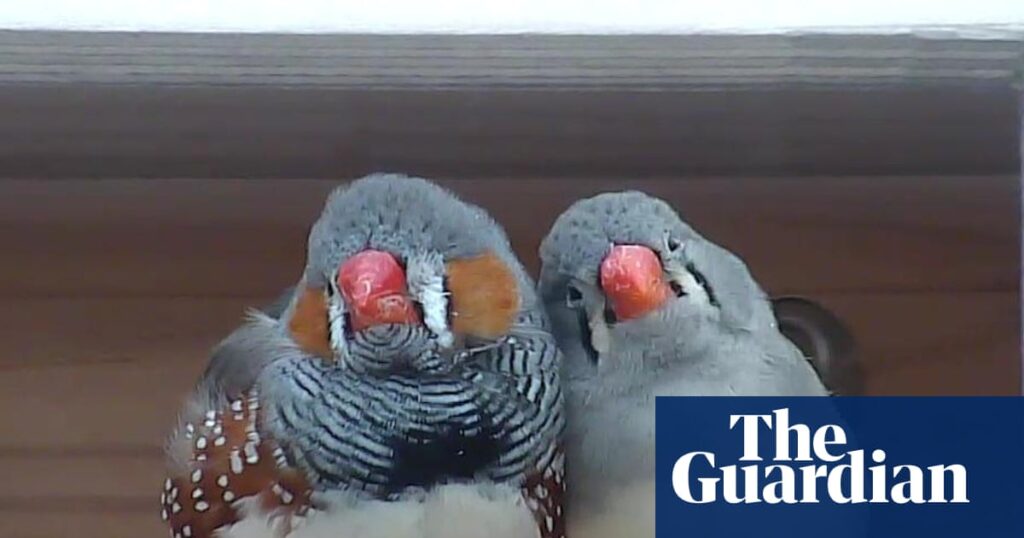

A scientist who decoded the dictionary that a bird uses to communicate has won a $100,000 prize for making progress towards a world in which humans can talk to the animals – without being met with a blank response.
Dr Julie Elie at the University of California, Berkeley, was awarded the 2026 Coller-Dolittle prize for two-way interspecies communication after working out the 11 core calls in the zebra finch vocabulary and their meanings.
Her work revealed how the birds announce who they are and what they are doing, and recognise one another regardless of what they are saying by using individual signatures. She also found that at times, the birds confused calls with similar meanings more than those that sounded the same.
“I’m really super-honoured,” Elie said on winning the prize, adding that she hoped the work was a step forwards in the “great endeavour” to communicate with animals. Prof Yossi Yovel, a zoologist at Tel Aviv University and chair of the panel of judges, said the work marked “a key moment in the field”.
The prize was launched in 2024 by the Jeremy Coller Foundation, which promotes awareness of animal welfare and animal sentience, in partnership with Tel Aviv University. Beyond the annual prizes for progress, the foundation has established a $10m grand prize for cracking the problem of two-way human-animal communication.
Elie decided to study zebra finches because they are so vocal – meaning they produce plenty of data. “The question I asked myself when hearing these chatty songbirds was what are they saying?” she said.
For more than a decade, Elie observed and recorded the sounds the birds made and classified the calls according to the situation and the bird that made them. She then used machine learning to analyse what and how information was encoded in the calls. Finally, she ran tests that showed the birds agreed with her classification.
In one test, zebra finches were played various calls from their repertoire when they tapped a button. Some calls were followed by a reward of some seeds. As the test went on, the birds learned to tap the button to skip unrewarding calls. It’s similar to scrolling videos on social media, Elie said, moving on when the start of the video looks dull.
The birds occasionally made mistakes, but when that happened, they often confused calls that had the same meaning rather than the same sound. “Their responses indicated they have a mental imagery of the meaning of their vocalisations,” Elie said. “In other words, that they understand the meaning of their call types.”
Prof Jonathan Birch, a philosopher at the London School of Economics, who was on the judging panel, said Elie had done “absolutely phenomenal work” for more than 15 years, “not just building up a dictionary of the 11 ‘core words’ of the zebra finch’s vocabulary, but also asking the finches themselves, through ingenious experimental techniques, whether she’s got the meanings right. It’s a stunning…
Source link
Disclaimer
We strive to uphold the highest ethical standards in all of our reporting and coverage. We blogs.grocliq.com want to be transparent with our readers about any potential conflicts of interest that may arise in our work. It’s possible that some of the investors we feature may have connections to other businesses, including competitors or companies we write about. However, we want to assure our readers that this will not have any impact on the integrity or impartiality of our reporting. We are committed to delivering accurate, unbiased news and information to our audience, and we will continue to uphold our ethics and principles in all of our work. Thank you for your trust and support.
Website Upgradation is going on for any glitch kindly connect at [email protected]