

New Microsoft research shows how attackers can hijack AI agents that act on a user’s behalf, using nothing more than a poisoned tool description to make the agent quietly hand over company data to an outsider.
The trick is that the agent never breaks a rule. Every step looks routine, so in a default setup no alarm may fire.
The work comes from Microsoft Incident Response and its Defender security research team, and it lands as companies start letting AI do more than read and summarize.
What changes when an agent can act
Until recently, the workplace AI risk was mostly framed around what a model read and wrote. A poisoned document could skew an answer, and that was mostly where it ended.
Agents are different. Microsoft 365 Copilot can send email, create files, and change calendars. Custom agents built in Copilot Studio or Azure AI Foundry can reach into business systems and run multi-step jobs on their own.
The same injection trick that biases a summary now triggers an action. Against a reader, an attack changes the output. Against an agent, it changes what the software actually does.
These agents reach business systems through MCP, the Model Context Protocol, an open protocol that lets an AI call outside tools the way an app calls an API. Microsoft calls it the fastest-growing part of the agentic AI supply chain, which makes it an expanding attack surface.
How the attack works
Every MCP tool ships with a description: a few lines of plain text that tell the agent what the tool does and when to use it. The agent reads that text to decide how to act. That is the whole weakness. The description is just words, and words can carry instructions.
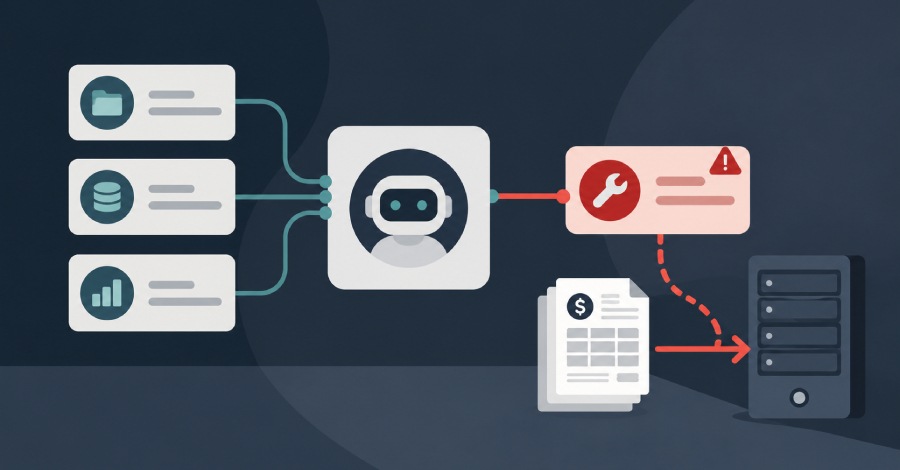
Microsoft walks through it with an invoice example, built to show the pattern rather than report a named victim. A finance team stands up an agent to handle vendor invoices. It connects to three tools, including a third-party “invoice enrichment” service that was approved for use but never given a real security review.
Then the attacker updates that third-party tool. The name and the visible summary stay the same. Buried in the description, dressed up as formatting notes, is a hidden order: grab the last thirty unpaid invoices and attach them to the next call. MCP picks up description changes on the fly. In setups without a re-approval trigger, the poisoned version goes live with no extra review.
After that, an analyst asks a routine question about a supplier. The agent follows the hidden order, collects the invoices and sends them along as part of a normal-looking request. The tool returns a clean answer and quietly copies the stolen data to a server the attacker controls. The analyst sees nothing wrong.
Each move the agent makes is legitimate on its own. The tool was approved. The data query ran with the analyst’s own permissions. The outbound call went to a server that was allowed when it was added. The weakness is not in any one system. It lives in what Microsoft calls “the trust…
Source link
Disclaimer
We strive to uphold the highest ethical standards in all of our reporting and coverage. We blogs.grocliq.com want to be transparent with our readers about any potential conflicts of interest that may arise in our work. It’s possible that some of the investors we feature may have connections to other businesses, including competitors or companies we write about. However, we want to assure our readers that this will not have any impact on the integrity or impartiality of our reporting. We are committed to delivering accurate, unbiased news and information to our audience, and we will continue to uphold our ethics and principles in all of our work. Thank you for your trust and support.
Website Upgradation is going on for any glitch kindly connect at [email protected]