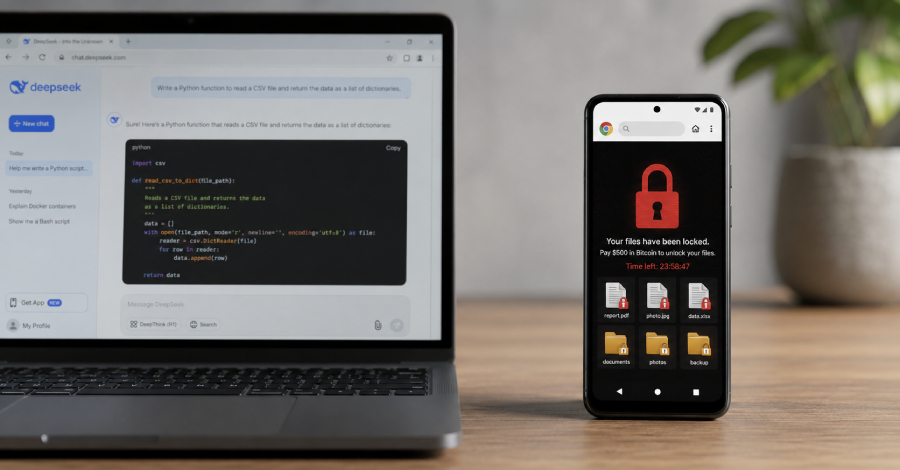


Cybersecurity researchers have flagged a new malware artifact generated using DeepSeek that constructed a novel attack path combining “unrealistic browser-malware concepts with a real browser capability” to turn it into a working ransomware technique that runs entirely inside the browser on both Windows and Android devices.
“This is the first documented case where a frontier AI model independently bridged the gap between a theoretical browser-only ransomware risk and a practical, working attack chain – surfacing a novel attack path that defenders had previously dismissed as unfeasible due to browser sandboxing limits,” Check Point said in a statement shared with The Hacker News.
“The expertise needed to discover a new attack path is no longer the bottleneck, and defenders need to account for that shift now — before threat actors operationalize it at scale.”
The identified sample is a Python Flask application named “deepseek_python_20260125_da0631.py” that was uploaded to VirusTotal on January 25, 2026, with the Google-owned malware scanning service describing it as a “fully functional information stealer and ransomware toolkit.” It has been named InfernoGrabber v9.0 by the malware author.
The application is designed to operate as a malicious web server that lures victims with a fake Discord avatar AI upscaler, while stealthily running a wide array of harmful actions, including stealing Discord tokens, harvesting credit card numbers and cryptocurrency seed phrases, logging keystrokes, and capturing unauthorized webcam and microphone feeds.
“The code includes specific routines for browser exploitation (targeting CVEs like CVE-2023-4863), data exfiltration via a hard-coded Discord webhook, a ransomware ‘WinLocker’ screen demanding Bitcoin, and an administrative dashboard for the attacker to manage stolen data,” according to VirusTotal.
The findings come as artificial intelligence and large language models (LLMs) are redefining the cyber threat landscape, enabling threat actors to abuse the technology to develop malware and exploits. The use of DeepSeek is noteworthy as it signals that the Chinese company’s models have lower refusal rates for malicious cyber requests when compared to its Western counterparts from Anthropic, Google, or OpenAI.
Other factors that may have facilitated the use of DeepSeek is its free access via the web interface, availability in regions where other frontier models do not operate, and its ability to generate a working malicious application from a “single broad prompt” as opposed to models from Anthropic or OpenAI.
“DeepSeek models can turn high‑level malicious ideas into concrete, complete attacks with less expertise than competing platforms,” Check Point Research said.
The Israeli cybersecurity company said it unearthed the Python artifact as part of its analysis of about 3,000 files attributed to DeepSeek over the past year. Of these, 1,383 samples have been classified as malicious or dangerous. The…
Source link
Disclaimer
We strive to uphold the highest ethical standards in all of our reporting and coverage. We blogs.grocliq.com want to be transparent with our readers about any potential conflicts of interest that may arise in our work. It’s possible that some of the investors we feature may have connections to other businesses, including competitors or companies we write about. However, we want to assure our readers that this will not have any impact on the integrity or impartiality of our reporting. We are committed to delivering accurate, unbiased news and information to our audience, and we will continue to uphold our ethics and principles in all of our work. Thank you for your trust and support.
Website Upgradation is going on for any glitch kindly connect at [email protected]