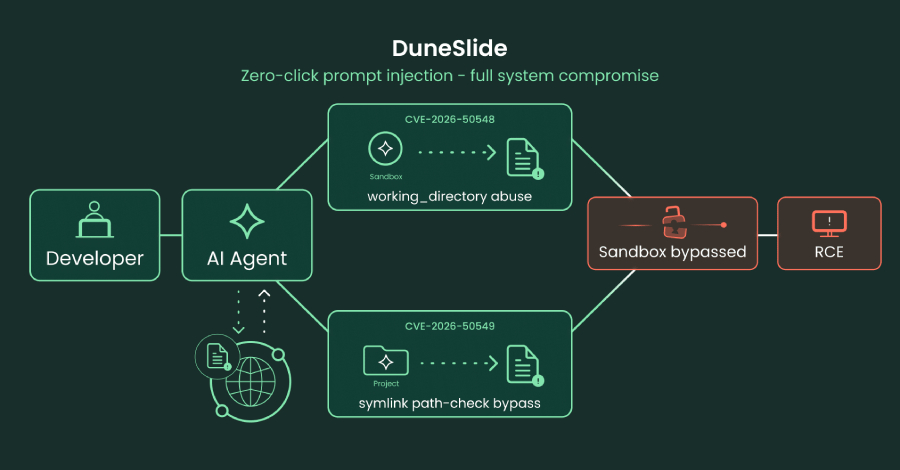


Two flaws in Cursor, an AI code editor, could let a single, ordinary-looking prompt break out of the editor’s safety sandbox and run any command on a developer’s computer. There is no click to fall for and no approval box to ignore.
Cato AI Labs found the pair and named them DuneSlide. They are tracked as CVE-2026-50548 and CVE-2026-50549, both rated 9.8 out of 10 (or 9.3 under the newer CVSS 4.0 scale).
The fix is already out. Both bugs are patched in Cursor 3.0, released April 2, and every version before 3.0 is affected. Cursor’s maker says more than half the Fortune 500 use the tool, so if you run it, update now.
What the sandbox was for, and how it broke
Starting in the 2.x line, Cursor runs the terminal commands its AI agent issues inside a sandbox by default: a locked box that limits what those commands can touch, so a stray instruction cannot wreck the machine.
DuneSlide is about getting out of that box. The way in is prompt injection. The attacker never types into your Cursor. They plant instructions inside something your agent reads on your behalf, such as a connected service through the Model Context Protocol (MCP) or a page returned by a web search.
You ask a normal question, the hidden instructions come along for the ride, and because it needs no click or approval from you, the attack is “zero-click.”
Both flaws use the same trick: get the agent to write one file it should not be allowed to write, then use that write to turn the sandbox off.
- CVE-2026-50548 abuses a setting. The sandbox permits writes into a command’s working folder, and that folder is an optional parameter, working_directory, on Cursor’s run_terminal_cmd tool. When the agent sets it to a non-default path, Cursor adds that path to the allowed-write list without question. Injected instructions point it at a system file instead of the project. Overwrite the sandbox helper itself (on macOS, /Applications/Cursor.app/Contents/Resources/app/resources/helpers/cursorsandbox), and later commands run with no sandbox at all. Startup files like ~/.zshrc work as targets too.
- CVE-2026-50549 abuses a safety check. Before writing, Cursor resolves shortcuts (symlinks) to confirm the real destination sits inside your project. The bug is the fallback: when that check fails, because the target does not exist or the attacker removes read access from a folder in the path, Cursor gives up and trusts the shortcut’s in-project path instead. An attacker creates a shortcut that points outside the project, forces the check to fail, and Cursor writes straight through it to the same sandbox helper. Same escape, different door.
Once the sandbox is neutralized, the next command runs as you. That means control of the developer’s machine, plus any cloud or SaaS workspaces the editor is signed into. It all follows from one harmless-looking prompt.
There is no sign this has been used in real attacks. Cato presents…
Source link
Disclaimer
We strive to uphold the highest ethical standards in all of our reporting and coverage. We blogs.grocliq.com want to be transparent with our readers about any potential conflicts of interest that may arise in our work. It’s possible that some of the investors we feature may have connections to other businesses, including competitors or companies we write about. However, we want to assure our readers that this will not have any impact on the integrity or impartiality of our reporting. We are committed to delivering accurate, unbiased news and information to our audience, and we will continue to uphold our ethics and principles in all of our work. Thank you for your trust and support.
Website Upgradation is going on for any glitch kindly connect at [email protected]