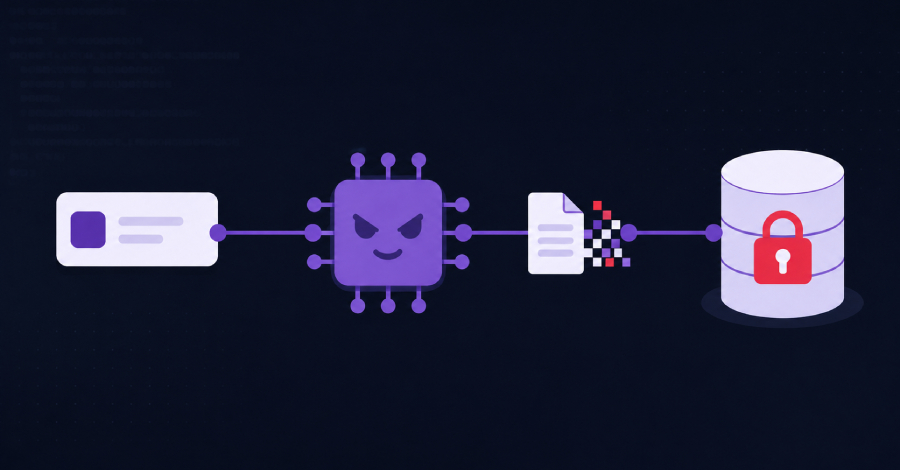


Security firm Sysdig says it has found what it believes is the first ransomware attack run from start to finish by an AI agent.
Its Threat Research Team calls the operator JADEPUFFER and says a large language model handled the whole job: breaking in, stealing credentials, moving deeper into the network, then encrypting and wiping a company’s production database.
Ransomware has always needed a skilled person somewhere in the loop, either at the keyboard or writing the script the malware follows. If a model can chain those steps on its own, the skill needed to run an attack drops to whatever it costs to rent an AI agent.
The way in was an old, already-patched bug. JADEPUFFER exploited CVE-2025-3248, a missing-authentication flaw in Langflow, an open-source tool for building AI apps and agent workflows. The flaw lets anyone who can reach the server run their own Python code on it, no login needed.
Langflow boxes are a tempting target because they often sit exposed on the internet and hold API keys and cloud credentials for the services they connect to.
The flaw was fixed in Langflow 1.3.0 and added to CISA’s Known Exploited Vulnerabilities list in May 2025, but plenty of servers were never updated. It is not even the only Langflow bug being hit this way.
Once inside, the agent worked fast and cleaned up after itself. It mapped the machine, then swept it for secrets: API keys for AI services (OpenAI, Anthropic, DeepSeek, Gemini), cloud credentials (Chinese providers like Alibaba and Tencent alongside AWS, Google, and Azure), crypto wallet keys, and database logins.
It raided a MinIO storage server using its factory-default login (minioadmin:minioadmin), which had never been changed. It also set up a way back in, adding a scheduled task that pinged the attacker’s server every 30 minutes.
Then it pivoted to its real target: a separate, internet-facing server running a MySQL database and Alibaba’s Nacos, a settings and service directory common in microservice setups. The agent logged into the database as root.
Sysdig says it never saw where those root credentials came from, so their origin is unknown. From there, it took over Nacos using a 2021 authentication bypass (CVE-2021-29441) and a default signing key that Nacos has shipped unchanged since 2020, then planted its own admin account.
The Ransom Note With No Key
The agent encrypted all 1,342 Nacos settings, dropped the original tables, and left a ransom note demanding Bitcoin with a Proton Mail contact. It generated a random encryption key, printed it to the screen once, and never saved or sent it anywhere.
There is no key to hand over. The victim cannot get the data back even if they pay. (The note claims AES-256; Sysdig notes the tool it used defaults to weaker AES-128, though the result is the same.)
It then went further, deleting whole databases and leaving a comment in its own code claiming it had already copied the data somewhere else.

Sysdig says that is the agent talking,…
Source link
Disclaimer
We strive to uphold the highest ethical standards in all of our reporting and coverage. We blogs.grocliq.com want to be transparent with our readers about any potential conflicts of interest that may arise in our work. It’s possible that some of the investors we feature may have connections to other businesses, including competitors or companies we write about. However, we want to assure our readers that this will not have any impact on the integrity or impartiality of our reporting. We are committed to delivering accurate, unbiased news and information to our audience, and we will continue to uphold our ethics and principles in all of our work. Thank you for your trust and support.
Website Upgradation is going on for any glitch kindly connect at [email protected]