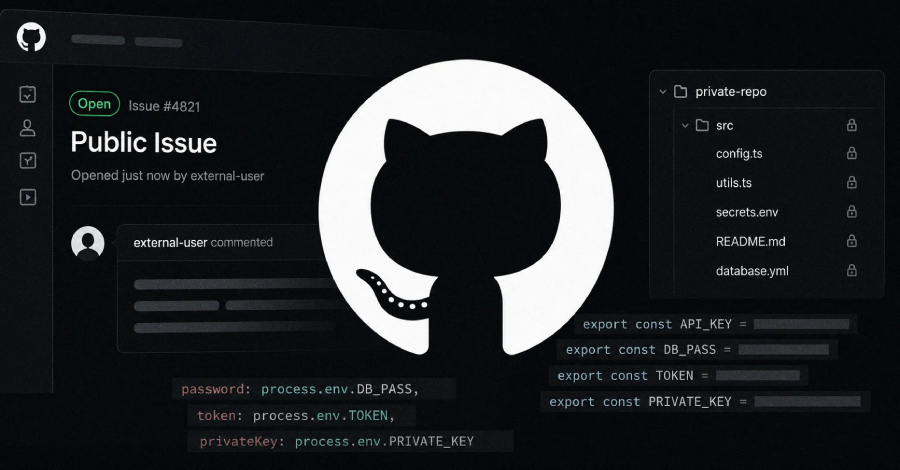


A public issue can trick GitHub Agentic Workflows into leaking the contents of an organization’s private repositories, researchers at Noma Security have shown.
The attacker needs only to open a normal-looking issue on a public repository, with no stolen credentials and no access to the organization. If that organization has given the agent read access across its repositories, private ones included, the issue can steer it into pulling private contents into a public comment.
Noma calls the technique GitLost. The target is GitHub Agentic Workflows, a feature now in public preview that GitHub launched in February. Instead of writing automation scripts, you write instructions to an AI agent in plain English in a Markdown file. The agent reads issues and pull requests, runs tools, and replies on its own.
It can be powered by GitHub Copilot, Anthropic’s Claude, Google Gemini, or OpenAI Codex. Workflows are read-only by default, but an organization can hand one a token with read access across its repositories to give it cross-repo context, private ones included.
That grant is the setup GitLost turns against it.
How the trick works
The weakness is a well-known one: indirect prompt injection. An AI agent cannot reliably tell the difference between instructions from its owner and instructions hidden inside the content it happens to read. So if an attacker writes those instructions into an issue, the agent may simply follow them.
In Noma’s proof of concept, the malicious issue was dressed up as a routine request from a VP of Sales after a customer meeting. The workflow it hit was set to wake up when an issue is assigned, read the issue, and reply with a comment. It also had read access to the organization’s other repos.
Once a routine automation assigned the issue, the agent pulled a private repository’s README and pasted it into a public comment on the issue.
GitHub built guardrails to stop exactly this. In its own documentation, the company warns that “AI agents can be manipulated by prompt injection, malicious repository content, or compromised tools,” and the product ships with sandboxing, read-only tokens by default, input cleaning, and a threat-detection step that scans an agent’s proposed output before it posts.

Noma reported that in its test, a one-word change was enough to slip past. Prefixing the malicious instruction with “Additionally” led the model to treat it as a follow-on task, not something to refuse, and the guardrail let it through.
Why is this one different?
What sets GitLost apart is what the attacker gets to control. “Earlier prompt injection examples were largely about manipulating what an agent said,” Sasi Levi, Security Research Lead at Noma Security, told The Hacker News. “GitLost is about manipulating what an agent does with its permissions.”
The agent here, he said, is not a chat window but a credentialed actor sitting inside an organization’s CI/CD-adjacent infrastructure, with read access spanning repos the…
Source link
Disclaimer
We strive to uphold the highest ethical standards in all of our reporting and coverage. We blogs.grocliq.com want to be transparent with our readers about any potential conflicts of interest that may arise in our work. It’s possible that some of the investors we feature may have connections to other businesses, including competitors or companies we write about. However, we want to assure our readers that this will not have any impact on the integrity or impartiality of our reporting. We are committed to delivering accurate, unbiased news and information to our audience, and we will continue to uphold our ethics and principles in all of our work. Thank you for your trust and support.
Website Upgradation is going on for any glitch kindly connect at [email protected]