

A Microsoft 365 device code phishing campaign has been observed leveraging collaboration-themed lures to take control of victim accounts between the last week of June 2026 and into early July, per findings from ZeroBEC.
“The campaign did not depend on a fake Microsoft password page. It used a malicious collaboration-style lure to push users into the legitimate Microsoft device login experience, while a backend broker generated and polled Microsoft Authentication Broker device-code tokens,” the email security company said in a report shared with The Hacker News.
The activity is assessed to share “strong” overlaps with a campaign documented by Microsoft in February 2025 under the moniker Storm-2372, including the use of messaging or Teams-style lures to trick unsuspecting victims into entering an attacker-provided device code, along with their credentials, effectively allowing the threat actor to recover the token and hijack their account.
Despite these similarities, it’s assessed that the threat actors are employing Storm-2372-style tradecraft through what has been described as a reusable tooling layer called DEBULL.
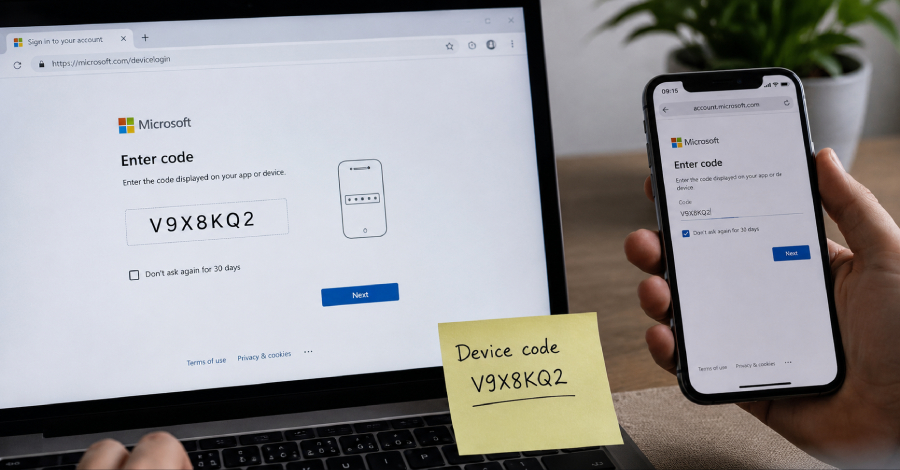
Device code phishing refers to an identity theft technique where attackers exploit a legitimate OAuth 2.0 authentication mechanism, specifically the Device Authorization Grant flow, to bypass multi-factor authentication (MFA) and gain persistent account access without having to steal user passwords.
Unlike traditional phishing attacks that require the operators to set up bogus adversary-in-the-middle (AitM) login pages, device code phishing relies on manipulating a user into completing a real, trusted authentication prompt.
Device code authentication, per Microsoft, is a legitimate OAuth flow designed for devices with limited interfaces, such as smart TVs or printers, that cannot support a traditional interactive login. In this scenario, a user is presented with a short code on the device they are trying to sign in from and is prompted to input that code into a web browser on a separate device to complete the authentication.
Threat actors have abused this separation to insert themselves and initiate the authentication flow. Then, they share that code with the target through a phishing lure. Thus, when the user enters the code, they authorize the threat actor’s session without their knowledge, granting them access to the account.
“Device code phishing doesn’t hack its way in,” Huntress notes. “It uses a legitimate authentication flow to walk right through the front door, with no password required, MFA bypassed, and session tokens handed straight to the attacker.”
Successful device code phishing attacks can facilitate full account takeover, theft of valuable information, fraud, business email compromise (BEC), lateral movement within a compromised environment, and even disruptive attacks like ransomware.

“In most current device code phishing attacks, the code is generated dynamically when a user clicks on the initial…
Source link
Disclaimer
We strive to uphold the highest ethical standards in all of our reporting and coverage. We blogs.grocliq.com want to be transparent with our readers about any potential conflicts of interest that may arise in our work. It’s possible that some of the investors we feature may have connections to other businesses, including competitors or companies we write about. However, we want to assure our readers that this will not have any impact on the integrity or impartiality of our reporting. We are committed to delivering accurate, unbiased news and information to our audience, and we will continue to uphold our ethics and principles in all of our work. Thank you for your trust and support.
Website Upgradation is going on for any glitch kindly connect at [email protected]