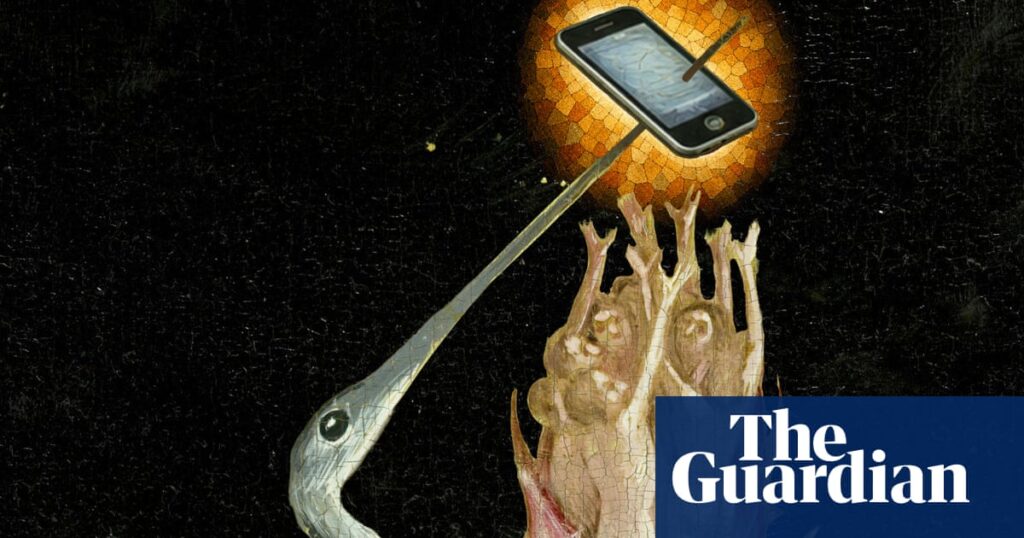

Do you want to have a good time? You know, really enjoy yourself? Click here, and tell us your desires. Maybe it’s a new outfit, or some exotic cuisine delivered anonymously and steaming hot to your door. Maybe it’s porn or gambling. Perhaps you prefer the infinite scroll, the endlessly unfurling ribbon of glossy images and videos starring people you’ll never meet doing things you’ll never do. Or maybe you favor talking to a chatbot who will assure you that you are the most special of all its users.
For anyone with an Internet connection and a little discretionary income, the contemporary moment offers a superabundance of seductive distractions. Why then the pervasive mood of emptiness? Why are so many at once overstimulated and bored?
Welcome to the era of decadence without pleasure.
The concept of decadence as a marker of cultural decline coinciding with a high level of wealth has been around since the twilight of the ancient Greeks and Romans. After the Roman emperor Elagabalus took the throne at 14, he served flamingo brains, seasoned his food with pearls, and, according to one account, smothered guests to death with an avalanche of rose petals. But his vices were outdone by Nero, who had his enemies sewn into wild animal skins and devoured by dogs in an elaborate garden spectacle.
So decadence has an inescapably pejorative ring, suggesting decay, excess and a falling away from norms and ideals. Critics of decadence have usually hailed from the political right, and the same is true today: consider conservative New York Times columnist Ross Douthat’s critique of cultural and economic stagnation in his 2020 book The Decadent Society, or billionaire investor Peter Thiel’s complaints about faltering innovation and the supposed decline of the west. JD Vance likes to invoke the fall of Rome, warning, in his 2026 memoir Communion, that the US is “a great civilization” tumbling into “disrepair”. But plenty of thinkers on the left also worry that modern wealthy societies have entered a period of paralysis, under the shadow of what the Italian theorist Franco “Bifo” Berardi calls “the slow cancellation of the future”.
That all sounds bad. Yet a passionate minority has sometimes found, in decadence, reasons for hope. Cultures later judged decadent produced extraordinary upwellings of art, like the flare of a dying star. Think of the undulating arabesques of Rococo painting before the French Revolution, or the lush shimmering silks of the late Ottomans, or the experimental cinema and nightlife of Weimar Berlin.
Nowhere was the cultural potential of decadence more visible than in the late-19th century. In France, Britain and (with less gusto) in the United States, artists such as Oscar Wilde, Aubrey Beardsley, Joris-Karl Huysmans and Rachilde developed new literary and…
Source link
Disclaimer
We strive to uphold the highest ethical standards in all of our reporting and coverage. We blogs.grocliq.com want to be transparent with our readers about any potential conflicts of interest that may arise in our work. It’s possible that some of the investors we feature may have connections to other businesses, including competitors or companies we write about. However, we want to assure our readers that this will not have any impact on the integrity or impartiality of our reporting. We are committed to delivering accurate, unbiased news and information to our audience, and we will continue to uphold our ethics and principles in all of our work. Thank you for your trust and support.
Website Upgradation is going on for any glitch kindly connect at [email protected]