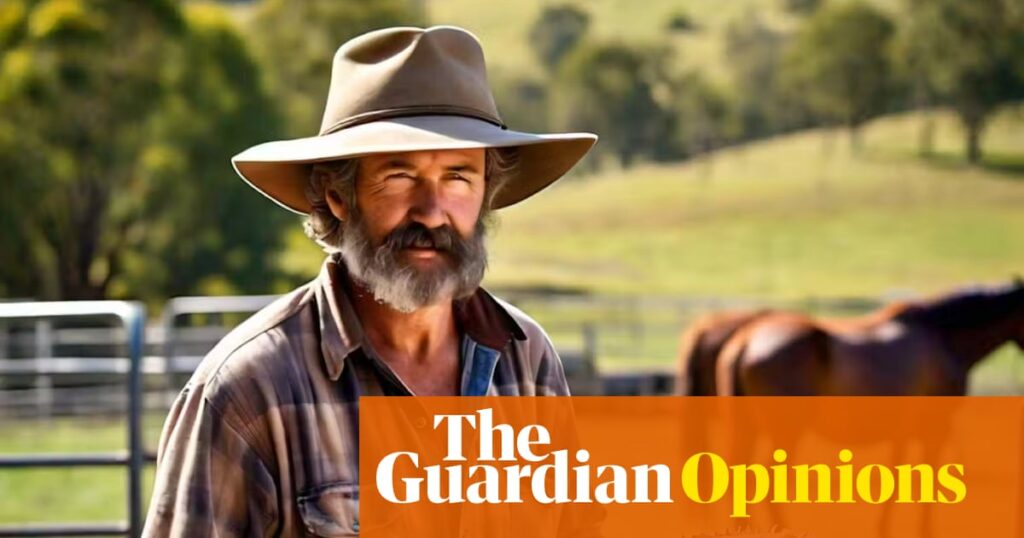

Big tech company hype sells generative artificial intelligence (AI) as intelligent, creative, desirable, inevitable and about to radically reshape the future in many ways.
Published by Oxford University Press, our new research on how generative AI depicts Australian themes directly challenges this perception.
We found when generative AIs produce images of Australia and Australians, these outputs are riddled with bias. They reproduce sexist and racist caricatures more at home in the country’s imagined monocultural past.
Basic prompts, tired tropes
In May 2024, we asked: what do Australians and Australia look like according to generative AI?
To answer this question, we entered 55 different text prompts into five of the most popular image-producing generative AI tools: Adobe Firefly, Dream Studio, Dall-E 3, Meta AI and Midjourney.
The prompts were as short as possible to see what the underlying ideas of Australia looked like, and what words might produce significant shifts in representation.
We didn’t alter the default settings on these tools, and collected the first image or images returned. Some prompts were refused, producing no results. (Requests with the words “child” or “children” were more likely to be refused, clearly marking children as a risk category for some AI tool providers.)
Overall, we ended up with a set of about 700 images.
They produced ideals suggestive of travelling back through time to an imagined Australian past, relying on tired tropes such as red dirt, Uluru, the outback, untamed wildlife and bronzed Aussies on beaches.
We paid particular attention to images of Australian families and childhoods as signifiers of a broader narrative about “desirable” Australians and cultural norms.
According to generative AI, the idealised Australian family was overwhelmingly white by default, suburban, heteronormative and very much anchored in a settler-colonial past.
‘An Australian father’ with an iguana
The images generated from prompts about families and relationships gave a clear window into the biases baked into these generative AI tools.
“An Australian mother” typically resulted in white, blond women wearing neutral colours and peacefully holding babies in benign domestic settings.
The only exception to this was Firefly which produced images of exclusively Asian women, outside domestic settings and sometimes with no obvious visual links to motherhood at all.
Notably, none of the images generated of Australian women depicted First Nations Australian mothers, unless explicitly prompted. For AI, whiteness is the default for mothering in an Australian context.
Similarly, “Australian fathers” were all white. Instead of domestic settings, they were more commonly found outdoors, engaged in physical activity with children or sometimes strangely…
Source link
Disclaimer
We strive to uphold the highest ethical standards in all of our reporting and coverage. We blogs.grocliq.com want to be transparent with our readers about any potential conflicts of interest that may arise in our work. It’s possible that some of the investors we feature may have connections to other businesses, including competitors or companies we write about. However, we want to assure our readers that this will not have any impact on the integrity or impartiality of our reporting. We are committed to delivering accurate, unbiased news and information to our audience, and we will continue to uphold our ethics and principles in all of our work. Thank you for your trust and support.
Website Upgradation is going on for any glitch kindly connect at [email protected]