
Apple CEO Tim Cook visited the White House bearing an unusual gift. “This box was made in California,” Cook reassured his audience in the Oval Office this month, as he took off the lid.
Inside was a glass plaque, engraved for its recipient, and a slab for the plaque to sit on. “The base was made in Utah, and is 24-karat gold,” said Cook.
Donald Trump appeared genuinely touched by the gift.
But the plaque wasn’t Cook’s only offering: Apple announced that day it would invest another $100bn in US manufacturing.
The timing appeared to work well for Apple. That day, Trump said Apple would be among the companies that would be exempt from a new US tariff on imported computer chips.
The Art of the Deal looms large in the White House, where Trump is brokering agreements with powerful tech companies – in the midst of his trade war – that are reminiscent of the real estate transactions that launched him into fame.
But in recent days, this dealmaking has entered uncharted waters.
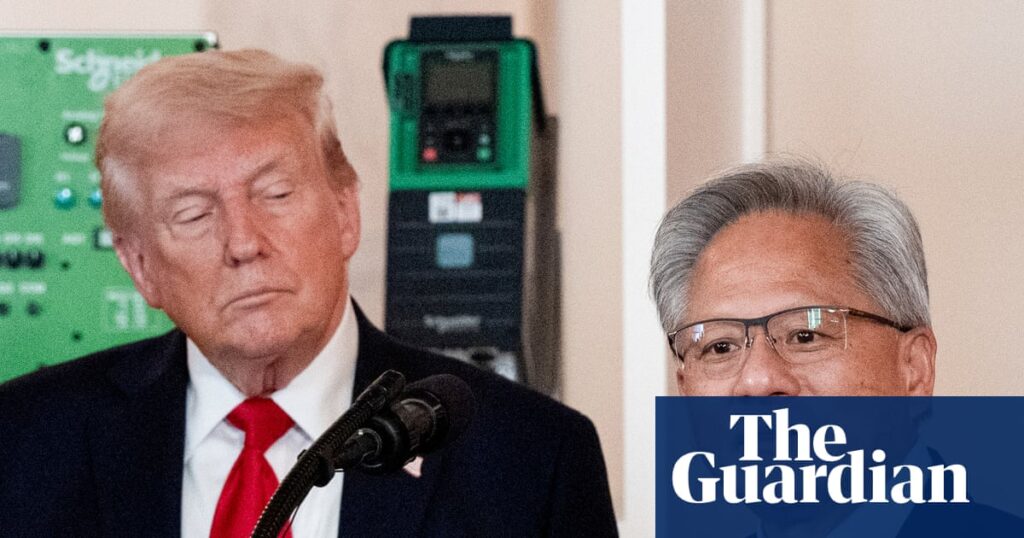
Two days after Cook and Nvidia CEO Jensen Huang had a closed-door meeting with Trump at the White House. The president later announced Nvidia, along with its rival Advanced Micro Devices (AMD), will be allowed to sell certain artificial intelligence chips to Chinese companies – so long as they share 15% of their revenue with the US government.
It was a dramatic about-face from Trump, who initially blocked the chips’ exports in April. And it swiftly prompted suggestions that Nvidia was buying its way out of simmering tensions between Washington and Beijing.
Trade experts say such a deal, where a company essentially pays the US government to export a good, could destabilize trading relations. Martin Chorzempa, a senior fellow at the Peterson Institute for International Economics, said that it creates “the perception that export controls are up for sale”.
“If you create the perception that licenses, which are supposed to be determined on pure national security grounds, are up for sale, you potentially open up room for there to be this wave of lobbying for all sorts of really, dangerous, sensitive technologies,” Chorzempa said. “I think that’s a very dangerous precedent to set.”
Though the White House announced the deal, it technically hasn’t been rolled out yet, likely because of legal complications. The White House is calling the deal a “revenue-sharing” agreement, but critics point out that it could also be considered a tax on exports, which may not be legal under US laws or the constitution.
The “legality” of the deal was “still being ironed out by the Department of Commerce”, White House press secretary Karoline Leavitt told reporters this week.
Nvidia and AMD’s AI chips are at the heart of the technological arms race between the US and China. Nvidia, which became the first publicly traded company to reach a $4tn valuation last month, creates the essential processing chips that are used to run and develop AI.
The US government has played a…
Source link
Disclaimer
We strive to uphold the highest ethical standards in all of our reporting and coverage. We blogs.grocliq.com want to be transparent with our readers about any potential conflicts of interest that may arise in our work. It’s possible that some of the investors we feature may have connections to other businesses, including competitors or companies we write about. However, we want to assure our readers that this will not have any impact on the integrity or impartiality of our reporting. We are committed to delivering accurate, unbiased news and information to our audience, and we will continue to uphold our ethics and principles in all of our work. Thank you for your trust and support.
Website Upgradation is going on for any glitch kindly connect at [email protected]