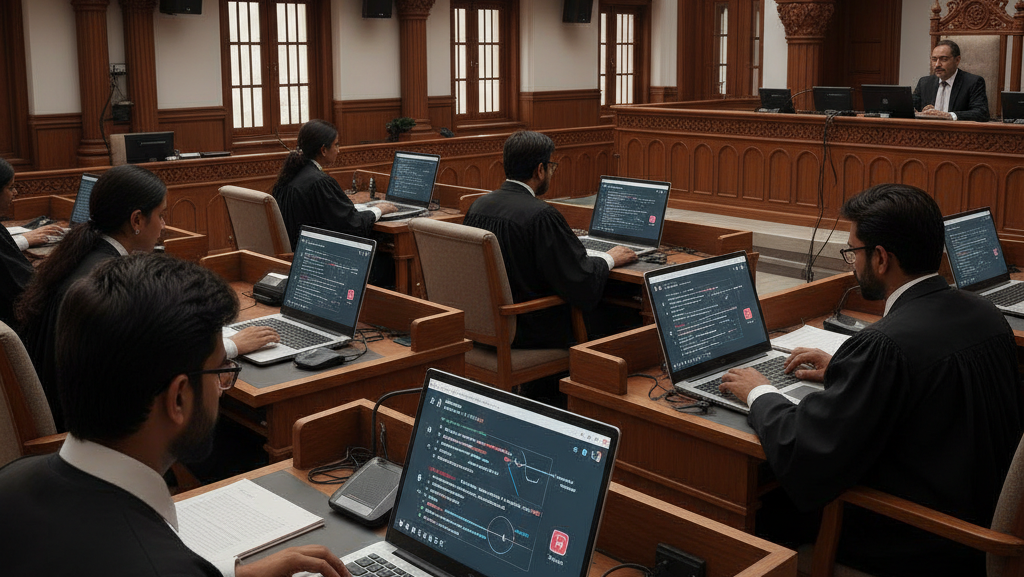

Justice Vikram Nath of the Supreme Court of India cautioned against over-reliance on artificial intelligence (AI) in the legal system, calling for strong safeguards and ethical oversight to ensure justice is not reduced to mere computation.
Speaking at a joint event organised by the Supreme Court Bar Association and the Orissa High Court Bar Association, Justice Nath said, “Artificial intelligence may inform the process of justice, but only human intelligence can deliver the essence of justice.”
In his keynote address, Justice Nath emphasised that while AI offers many benefits in improving access to justice and streamlining processes, it also brings serious risks that cannot be ignored. “Technology is powerful, but power without value is dangerous. We must not allow AI to become a substitute for human wisdom.”
He noted that AI has already entered Indian courtrooms in many helpful ways. “The Supreme Court of India has already taken significant steps with the e-courts project, which includes digitisation of records, e-filing and virtual hearings, transcription services and translation of judgements,” he said.
Justice Nath highlighted that the court is already using AI-assisted transcription for Constitution Bench matters.
However, he warned that these advancements must be approached with caution. “A judge is not an algorithm. A judge is a human being guided by constitutional morality, empathy and lived experience. A machine cannot understand the anguish of a victim, the remorse of an accused, or the complexities of social context. Justice is not a product. It is a process. And in that process, dignity is non-negotiable.”
Algorithmic Bias and Lack of Transparency
Justice Nath raised concerns about algorithmic bias, where Artificial Intelligence systems trained on biased data can produce unfair results. “If the data reflects social prejudices based on race, caste, gender, or economic status, the algorithm produces and sometimes amplifies those biases.”
He also spoke about the lack of transparency in how AI systems make decisions. “Most AI operate as a black box. It produces an answer without showing the reasoning. In law, reasoning is not optional. It is the very essence of justice. A judgement without reasons is not a judgement at all.”
He stressed that any Artificial Intelligence system used in the justice system must be explainable and transparent.
The Accountability Problem
Justice Nath asked a critical question about accountability: “If an AI tool gives a wrong answer, say it misquotes or generates a defamatory statement, who bears responsibility? The programmer, the platform, the user or the AI itself?”
He pointed out that India’s current legal framework is not yet equipped to deal with this question clearly. His remarks echoed the same concerns raised by Justice Gavai earlier in March this year when Gavai spoke of ChatGPT generating fake citations and fabricated…
Source link
Disclaimer
We strive to uphold the highest ethical standards in all of our reporting and coverage. We blogs.grocliq.com want to be transparent with our readers about any potential conflicts of interest that may arise in our work. It’s possible that some of the investors we feature may have connections to other businesses, including competitors or companies we write about. However, we want to assure our readers that this will not have any impact on the integrity or impartiality of our reporting. We are committed to delivering accurate, unbiased news and information to our audience, and we will continue to uphold our ethics and principles in all of our work. Thank you for your trust and support.
Website Upgradation is going on for any glitch kindly connect at [email protected]